Perfume atomisers and spray mechanisms: dose, leaks, travel and refilling
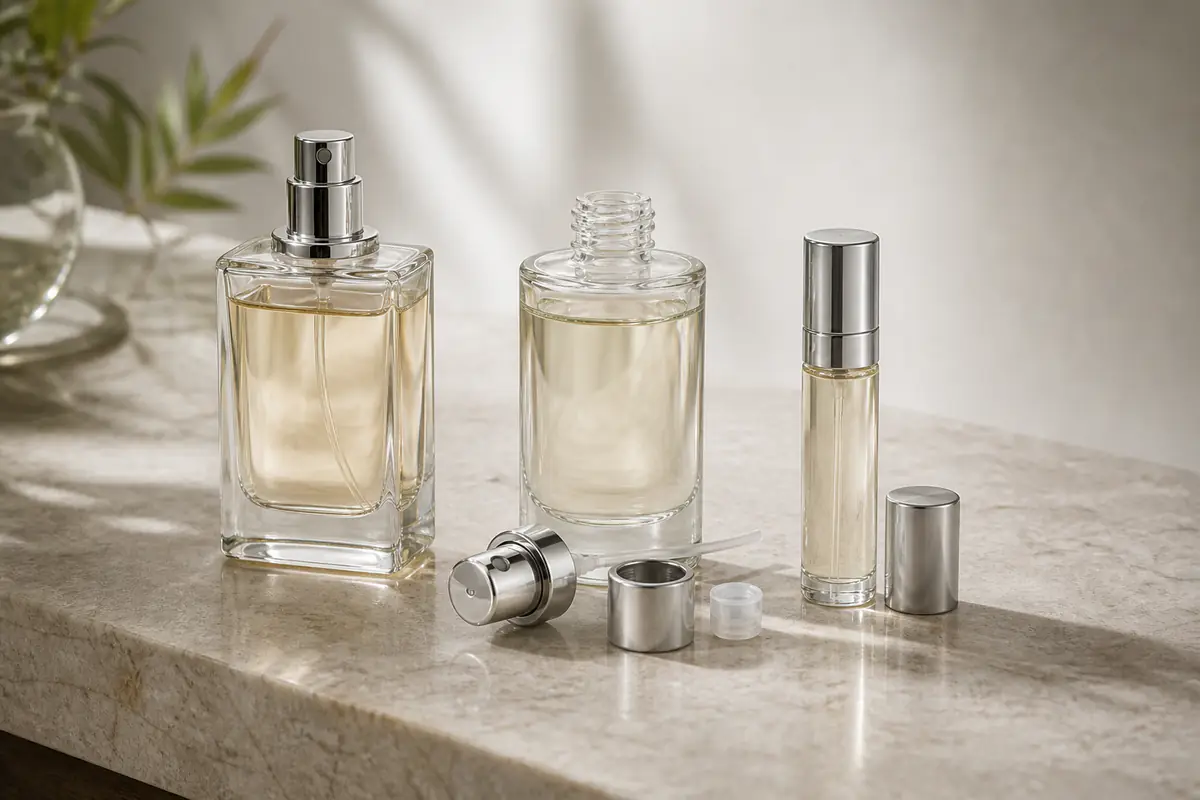
The atomiser controls how fragrance leaves the bottle. Spray pattern, dose, seals, cap and refill method affect application, leakage, oxidation risk and travel practicality even when the liquid is unchanged.
In this guide
Treat the atomiser as functional packaging
Choose a mechanism that produces a consistent useful spray, seals reliably and can be transported or refilled only by the stated method. Do not prise open crimped bottles, transfer unknown liquids or assume a small container automatically meets every airport rule.
Compare bottle volume in the perfume size guide, protect the liquid with the storage guide, and understand formulation labels in the concentration explainer.
| Mechanism | Potential benefit | Check | Main risk |
|---|---|---|---|
| Fixed crimp pump | Factory seal and consistent use | Pattern, cap and faults | Unsafe forced opening |
| Screw-off pump | Designed refill access on some bottles | Seal and compatibility | Cross-threading or contamination |
| Bottom-fill travel atomiser | Fast transfer from compatible stem | Valve match and leakage test | Loss and poor seal |
| Funnel or pipette decant | Controlled transfer where permitted | Clean tools and stable bottle | Spills and contamination |
Atomiser evidence checklist
- Exact bottle and closure design.
- Spray pattern and consistency.
- Dose assumption and application routine.
- Cap fit and accidental-press protection.
- Leak evidence at neck, pump and travel valve.
- Manufacturer refill or transfer instructions.
- Container capacity and travel rules.
- Batch, opening date and storage history.
Separate fragrance from delivery
The same liquid can feel different when a pump produces a fine cloud, narrow jet or uneven droplets. Distribution changes coverage and how quickly the top notes are perceived.
Do not infer concentration from spray strength. Use the exact label and concentration guide; the atomiser controls delivery, not formula category.
Inspect spray pattern safely
Test only as directed, away from eyes, flame and delicate surfaces. Observe whether the plume is even, whether the button returns and whether liquid collects around the nozzle.
A first partial press after storage may differ from normal operation. Do not repeatedly waste product merely to create a visually perfect cloud.
Do not assume a universal dose per spray
Pump output varies by bottle, actuator, press depth, liquid and wear. Online claims assigning one millilitre figure to every spray are unreliable without model-specific measurement.
For value, count realistic sprays used per wearing over several weeks rather than converting bottle volume through an invented universal dose.
Check the neck and seal
Look for dampness, staining, looseness or scent around the collar after normal upright storage. A strong smell near the bottle can come from residue as well as a leak.
Wipe only as permitted and monitor. Do not tighten, crimp or glue a fragrance closure unless the manufacturer supplies that repair route.
Value the cap as protection
A secure cap can reduce accidental presses and protect the nozzle in a bag, but it does not make the bottle leak-proof. Check fit without forcing it.
Magnetic or heavy decorative caps can feel premium without improving the pump. Judge retention, portability and replaceability rather than weight or sound.
Distinguish crimped and screw closures
Many factory bottles use a crimped collar not intended for consumer removal; some refillable systems provide a screw-off pump or dedicated cartridge. Identify the exact design.
Forcing a crimp can cause glass damage, spills, evaporation and contamination. Refillable marketing should be supported by compatible official components and instructions.
Audit bottom-fill travel atomisers
A bottom-fill device usually presses onto a compatible exposed valve stem. Confirm stem dimensions, adapter requirements, capacity and valve design before removing any spray head.
Test with the manufacturer-approved method over a protected surface. Stop if the fit is loose, the valve sticks or liquid appears around the base.
Use funnels or pipettes only when supported
For a screw-open bottle, a clean dedicated funnel or pipette can reduce splashing. Follow exact instructions and avoid touching tools to skin or another fragrance.
Do not return transferred liquid to the original bottle. Mixing traces can change scent and complicate hygiene and fault evidence.
Keep decants identifiable
Record fragrance name, concentration, batch where practical, transfer date and original bottle. Use a label that remains legible without claiming the small container is original retail packaging.
Never place fragrance in a food or medicine container. An unidentified clear liquid creates household and travel risk.
Prevent cross-contamination
Use one cleaned and fully dried compatible tool per fragrance or follow the maker’s replacement method. Residual water, cleaner or another scent can alter the decant.
Do not share a roll-on or applicator that contacts skin. Atomising avoids some contact but the container and cap still need clean handling.
Check travel capacity and current airport rules
Perfume is treated as a liquid for aviation security. UK airport rules can differ, and most airports still require containers no larger than 100 ml while some allow more after equipment changes.
Check departure, connection and return airports immediately before travel. A partly filled large bottle can still fail a container-size rule.
Pack for pressure and impact
Use the cap, keep the bottle upright where practical and place it in a sealed protective bag within a padded space. A travel atomiser reduces bulk but is not guaranteed leak-proof.
Do not overfill or expose perfume to heat. Inspect seals before packing and keep it away from electronics, documents and fabrics that could be damaged.
Store the pump and liquid together correctly
Keep the bottle closed, upright and away from strong heat and light as directed. Repeated decanting exposes liquid and increases handling opportunities.
Use the perfume storage guide. A dark decorative box cannot compensate for a leaking or open mechanism.
Handle a blocked or failed pump conservatively
Check the official troubleshooting route and inspect for visible damage. Do not insert pins, apply heat or direct the nozzle towards the face.
Preserve bottle, batch, order and photographs for the retailer or manufacturer. Use the warranty and guarantee guide for remedies.
Check cosmetics and product information
Transferred fragrance remains a cosmetic product, but a private decant loses convenient access to original warnings, ingredients and Responsible Person details. Keep the original packaging record.
The UK cosmetics-label guide explains traceability. Do not sell or gift informal decants as though they were authorised retail products.
Calculate value without invented spray counts
Use actual wearings, average presses and remaining volume over time. Include the cost and failure rate of any travel atomiser or refill component.
The bottle-size guide helps choose volume. A refill mechanism has value only when it works repeatedly without leakage, contamination or unused excess.
Run a dry packing rehearsal before travel: place the empty atomiser or securely closed bottle in its protective bag, orient it as intended and check pressure from neighbouring objects. Then perform any manufacturer-permitted leak check with the actual filled container well before departure. Do not discover a faulty valve beside documents or electronics.
For a refillable retail system, calculate the first purchase and each later refill separately. Include the reusable case only once, but do not assume future refill availability or universal compatibility. Save the system name, bottle generation and official refill method so a visually similar cartridge is not forced into the wrong closure.
Treat evaporation and residue as evidence questions, not reasons to overtighten parts. A lowering liquid line can reflect use, handling or a genuine seal issue. Keep the bottle upright in stable conditions, mark the observation date and contact the official support route if loss continues.
When gifting or sharing travel space, keep the original identity and safety information accessible. A plain unlabelled atomiser may be elegant but creates confusion about ownership, ingredients and exposure. Use a durable private identification method and never represent a decant as sealed original merchandise.
Keep spare caps, collars or adapters only when the official system identifies them as compatible. Loose unidentified parts encourage force and cross-use later. Store them clean and dry with the product record, and discard damaged seals rather than treating a temporary absence of leakage as proof of safety.
Factory bottle or travel atomiser?
Seal and original traceability lead
The size is practical and the original pump, cap and storage route are reliable.
Small portable capacity is needed
Compatibility, clean transfer, identification, leakage checks and current travel rules all pass.
Balanced verdict
A perfume atomiser is precision packaging, not a disposable detail. Judge spray consistency, seals, cap and supported refill route, then keep travel capacity, hygiene and traceability explicit.
The linked size, storage, concentration and cosmetics-label guides cover the liquid and ownership questions.
Official checks:
GOV.UK cosmetics market guidance ↗
GOV.UK consumer cosmetics guidance ↗
GOV.UK hand luggage liquid rules ↗
GOV.UK product safety advice ↗
Frequently asked questions
How much perfume comes out in one spray?
There is no universal dose. Pump, bottle, liquid and press depth vary; use actual wear records rather than a generic figure.
Can every perfume bottle be refilled?
No — Some are crimped and not designed to open; use only the exact supported refill or transfer method.
Are bottom-fill atomisers leak-proof?
Do not assume so — Verify valve compatibility, fill correctly and perform a careful upright leak check before packing.
Can I take perfume in hand luggage?
Perfume counts as liquid. Check the current rules for every airport; container limits can differ.
What should I do if the pump stops?
Follow official troubleshooting, preserve evidence and contact the seller or maker; do not use pins, heat or unsafe force.
Methodology and limitations
We assessed perfume atomisers through spray pattern, dose uncertainty, pump return, seals, caps, crimp and screw closures, travel atomisers, clean transfer, identification, leakage, aviation rules, storage, faults, traceability and value. Official Great Britain cosmetics and current UK airport-liquid guidance was reviewed on 1 September 2026. We did not open or test a named bottle.
Limitations
Mechanisms, compatibility and airport rules vary, while fragrance formulas can react to storage and contamination. Verify the exact bottle, manufacturer method and every airport immediately before travel.