OLED vs IPS Laptop Screens: Battery, Glare, Colour and Burn-In
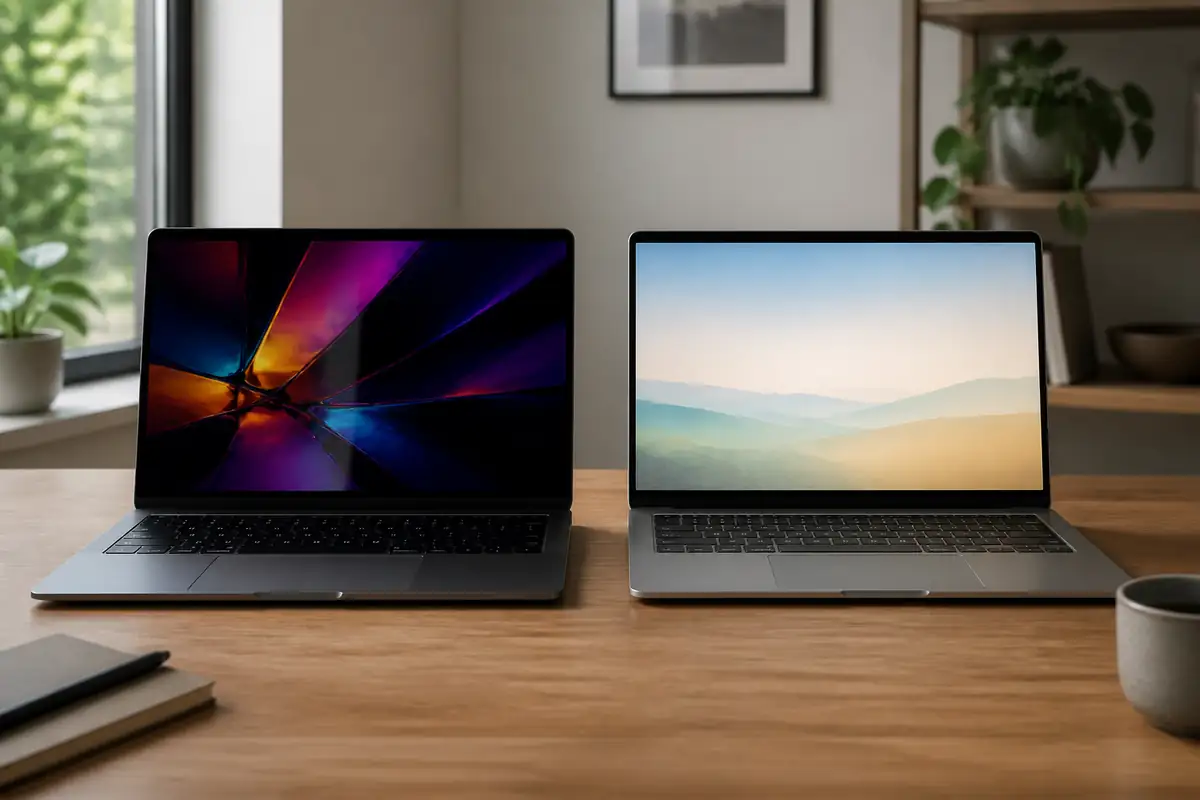
OLED gives exceptional black levels and contrast; IPS often delivers a calmer matte work surface, predictable text and fewer long-term image-retention concerns.
In this guide
Choose the screen for the room and workload—not for the panel badge.
OLED is the stronger choice for films, dark-room use, high-contrast creative work and buyers who value deep blacks. A good IPS display is usually the safer all-day office choice when matte glare control, static documents, battery predictability and replacement cost matter. Resolution, brightness, coating, colour coverage and refresh rate can outweigh the panel family.
An OLED laptop is not automatically premium and an IPS laptop is not automatically dull. Retailers sell low-resolution, dim versions of both as well as excellent ones. This guide compares how the technologies behave, then shows how to read the complete specification without claiming performance we have not measured.
OLED vs IPS: the differences that matter
| Decision area | OLED laptop | IPS laptop |
|---|---|---|
| Black level and contrast | Pixels can switch off individually, producing very deep blacks | Backlight remains behind the panel, so dark scenes can appear grey in a dim room |
| Bright-room visibility | Often glossy; strong contrast does not remove reflections | Frequently available with a matte anti-glare finish |
| Colour | Often sold with wide-gamut claims; can look highly saturated | Ranges from basic office panels to accurate wide-gamut professional displays |
| Battery behaviour | Consumption varies with image brightness; dark interfaces may use less than white pages | Backlight draw is more consistent across light and dark content |
| Static content | Long-term uneven pixel ageing and retention require sensible care | No OLED-style permanent burn-in mechanism |
| Price and choice | Available well below four figures, but still common in premium configurations | Far wider choice across budget, business and gaming laptops |
OLED is self-emissive: each pixel produces its own light. IPS is a type of liquid-crystal display that controls light from a backlight. That architecture explains most visible differences, but it does not tell you whether one exact screen is bright enough outdoors, accurately calibrated or comfortable for your eyes. A complete listing should state resolution, refresh rate, brightness, colour gamut, finish and whether touch is included.
Current UK laptop price examples
These examples show where each technology appeared in current retailer catalogues on 21 August 2026. They are not matched computers: processor, operating system, chassis, memory and stock status differ, so the price gap cannot be attributed to the screen alone.
| Exact listing | Panel and key configuration | Price/status shown | What it demonstrates |
|---|---|---|---|
| HP OmniBook 7 AI 14 Currys |
OLED; Core Ultra 5 225U; 16GB; 512GB | £649; listed for delivery | OLED is no longer confined to four-figure laptops; note that the headline says “2K” while the technical table states 1920 × 1200 |
| Acer Extensa 15 EX215-24 Scan |
15.6-inch Full HD IPS; Ryzen 5 7520U; 16GB; 512GB | £579.98; in stock with free delivery shown | A lower-priced IPS machine can prioritise a larger matte office screen rather than contrast |
| ASUS Zenbook 14 UX3405 Scan |
2880 × 1800 OLED; Core Ultra 5 125H; 16GB; 512GB | £1,099.99; awaiting an ETA | Premium cost includes more than OLED; pre-order status is not equivalent to available stock |
| Lenovo ThinkPad X1 Carbon Laptops Direct |
14-inch 2.8K OLED; Core Ultra 7; 16GB; 512GB | £1,699.97 | A business chassis can combine OLED with portability, but configuration and support drive value |
Price and availability snapshot: checked on the official Currys, Scan and Laptops Direct UK pages on 21 August 2026. Prices, delivery promises, stock and configurations can change. Recheck the exact product code and basket before buying.
The £649 OLED example is important because it disproves the shortcut that OLED always demands a four-figure budget. It does not make that HP the automatic winner. The lower-priced IPS laptop may have different ports, battery size, keyboard, repair route or processor behaviour. Compare panel type only after matching the features that determine whether the computer can do the work. Our guide to shortlisting products keeps that order clear.
Black levels, contrast and dark-room use
OLED’s clearest advantage appears in dark content. A black pixel can switch off, so subtitles, stars and shadowed scenes sit against a genuinely dark background without the grey glow created by an LCD backlight. This also helps high-contrast interfaces and previewing photographs with deep shadows.
IPS contrast varies. A good panel can look excellent in ordinary daylight, while dark-room black remains limited by the backlight and may show brighter corners or “IPS glow” from an angle. That does not make IPS unsuitable for films. If most viewing happens in a bright room, reflections and maximum useful brightness may matter more than perfect black.
Glare, coating and working with text
Many OLED laptops use glossy or semi-glossy surfaces because they preserve perceived contrast and colour. A window, ceiling light or pale shirt can become a visible reflection. High peak brightness helps but does not erase a mirror-like image. Test the laptop with a dark screen in the type of room where it will be used.
IPS laptops are widely available with matte anti-glare coatings. That can be more comfortable for long documents, spreadsheets and coding in mixed office light. Matte is not universally superior: a coarse coating can make light backgrounds appear slightly grainy. The decision is glossy versus matte in your environment, not OLED versus IPS in isolation.
Text quality also depends on resolution, scaling and pixel structure. Some OLED subpixel layouts can produce coloured fringing around fine text at low pixel densities, especially when viewed closely. A high-resolution 14-inch OLED often reduces the visibility of that effect. Check real text at the intended Windows scaling rather than relying on a saturated demo image. Our screen-specification guide explains resolution, pixel density, brightness and refresh rate separately.
Colour accuracy: wide gamut is not the same as correct colour
OLED laptops are often promoted with DCI-P3 coverage, HDR or a validation badge. Wide gamut means the panel can reproduce a larger range of colours; it does not prove that every colour is accurate or that applications manage the gamut correctly. Unmanaged content can appear oversaturated.
IPS spans a much wider quality range. A cheap office panel may cover only a modest portion of sRGB, while a professional IPS display can be calibrated accurately and remain stable across viewing angles. For paid colour work, seek measured coverage, delta-E results, calibration support and the correct colour-management workflow. Neither technology replaces evidence from the exact model.
Which uses less battery?
There is no universal answer. An OLED pixel uses power according to the light it produces. A dark interface or film with many dark scenes can reduce panel demand; a white document or bright website lights a large proportion of pixels. IPS uses a backlight, so changing a page from black to white usually changes panel power less at the same brightness.
Resolution and refresh rate complicate the comparison. A 2.8K 120Hz OLED may render and refresh far more pixels than a Full HD 60Hz IPS panel. Touch layers and high brightness also matter. Manufacturer battery claims use controlled settings and workloads; they cannot isolate the screen for your day. Read our guide to battery-life claims, then seek independent tests of the exact laptop.
For mobile office work dominated by white documents, a lower-resolution IPS configuration can be the predictable endurance choice. For dark-mode coding or media, OLED may perform better than the stereotype suggests. Use the brightness you genuinely need and enable adaptive refresh or power-saving features where they do not disrupt the work.
OLED burn-in and image retention: should you worry?
OLED pixels age as they emit light. If one area displays the same bright taskbar, logo or application chrome for very long periods, it can age differently from its neighbours and leave a persistent trace. Temporary image retention can also occur and later clear. “Burn-in” usually refers to permanent uneven ageing.
Modern laptops use mitigations such as pixel shifting, panel refresh routines, automatic dimming and screen savers. These reduce risk; they do not change the underlying ageing mechanism. A buyer using changing content for a few hours a day faces a different exposure from a reception desk showing the same dashboard at high brightness for ten hours daily.
Sensible OLED care without anxiety
- Use automatic screen-off and a short idle timeout.
- Allow manufacturer maintenance routines to run as designed.
- Avoid leaving one bright static layout at maximum brightness all day.
- Auto-hide fixed interface elements where practical.
- Keep system and display firmware current.
- Read the guarantee wording; do not assume image retention is covered.
IPS is the lower-risk choice for permanently static dashboards, tills, monitoring screens and office layouts that rarely move. For mixed personal use, burn-in should be considered rather than sensationalised. Useful life also depends on battery wear, hinges, keyboard, ports and software support; see our product lifespan guide.
Refresh rate, response and gaming
OLED pixels can change state very quickly, producing clear motion with less smearing. That is valuable in games, but refresh rate still limits how often the display receives a new frame. A 60Hz OLED is not a substitute for a 144Hz screen when high refresh is the requirement.
IPS gaming panels commonly offer 144Hz, 165Hz or more at accessible prices. Verify adaptive-sync support, response behaviour across refresh rates and whether the laptop GPU can produce enough frames at the native resolution. A high-resolution OLED may look superb while demanding more from the graphics processor. Our gaming-laptop GPU comparison shows why display resolution, graphics power and cooling must be judged together.
Who should choose OLED?
Choose OLED when films, photography, illustration or dark-room contrast are central; you accept a glossy surface; and the exact model’s resolution, brightness and colour modes are suitable. It is also compelling when a current OLED configuration costs no more than a weaker IPS alternative after matching processor, memory and storage.
Do not choose it solely because a retailer labels it “vivid”. Check PWM or flicker behaviour if you know you are sensitive, and test text rendering. Keep the return route intact until the screen has been viewed under realistic lighting.
Who should choose IPS?
Choose IPS for long days of documents, static application chrome, bright offices and buyers who want a broad range of matte displays. It is often the practical option for education, administration and business fleets where predictable replacement cost matters.
Demand actual specifications. “IPS-level” is marketing language rather than a complete performance standard. Avoid a dim, low-gamut screen merely because the technology is familiar. A good IPS panel should state brightness, colour coverage and resolution; independent measurements should confirm them.
How to compare two exact laptops
- Match the workload. Set minimum processor, memory, storage and port requirements first.
- Record the complete display line. Panel, size, resolution, refresh, brightness, finish, touch and colour coverage.
- Check the room. Decide whether reflections or dark-room black will matter more.
- Compare battery evidence. Use exact-model testing with similar brightness, not family claims.
- Check repair and guarantee. A bonded premium panel can be expensive to replace.
- Match the final basket. Include delivery, charger, dock and the retailer’s return route.
Our 16GB versus 32GB RAM guide handles memory separately, while the Currys review and Scan Computers review explain the transaction choices behind these retailer examples.
Contrast and media quality lead
You prioritise films, photography or creative work, can manage reflections and static-content precautions, and the exact panel’s colour, text rendering and battery evidence suit your routine.
Long static work and practicality lead
You spend long days in documents or bright rooms, value matte-screen choice and predictable power use, and do not want to manage OLED ageing risk.
Our verdict
OLED is the visual-quality winner for deep blacks and dark-scene contrast, but IPS remains the default recommendation for static office work and difficult bright-room reflections. Neither label tells you enough to purchase. A matte, bright, colour-accurate IPS panel can be better than a glossy entry OLED for an office; a high-resolution OLED can transform media and creative work.
Write down the dominant content and room, then compare the exact screen line. Do not pay for saturated shop-floor demos when the real day is six hours of white spreadsheets. Browse more Tech & Audio guides or compare retailers in the shop directory.
Check current official listings:
Currys HP OmniBook OLED listing ↗Scan Acer Extensa IPS listing ↗Scan ASUS Zenbook OLED listing ↗Laptops Direct ThinkPad OLED listing ↗
Frequently asked questions
Is OLED always better than IPS on a laptop?
No. OLED gives deeper blacks and very high contrast, while IPS often offers a matte finish, predictable static-content use and broader low-cost choice. Exact brightness, colour, resolution and coating matter more than the label alone.
Does OLED reduce laptop battery life?
It depends on content, brightness, resolution and refresh rate. Dark content can use relatively little panel power; large white pages can use more. Compare independent battery tests of the exact configuration.
Will an OLED laptop get burn-in?
Permanent uneven ageing is possible, especially with bright static content over long periods. Modern protection features and varied ordinary use reduce risk, but do not eliminate the mechanism. Check guarantee wording.
Is IPS better for office work?
Often, particularly when a matte surface and static documents dominate. A high-resolution OLED can still be excellent for office work if reflections, text rendering and battery behaviour suit the user.
Which is better for photo editing?
Either can be suitable when the exact panel is accurate, covers the required gamut and supports a managed workflow. OLED black levels do not replace calibration; IPS technology does not guarantee sRGB coverage.
Which is better for gaming?
OLED usually offers faster pixel response, while IPS gaming laptops provide a wide choice of high refresh rates. Match refresh, resolution, adaptive sync and GPU performance rather than choosing panel type alone.
How we compared OLED and IPS laptops
Recommended Today rechecked the exact official Currys, Scan and Laptops Direct UK listings on 21 August 2026. We recorded panel descriptions, configurations, displayed prices, delivery or stock status and a specification discrepancy on the HP page. We compared the technologies using their physical operating differences and did not treat unmatched laptops as a controlled price experiment.
We did not buy, calibrate, measure or use these laptops. We therefore make no exact-model claims about brightness, colour error, battery runtime, PWM, response time or burn-in.
Prices, delivery, stock, specifications and guarantees change. Recheck every exact product code and term immediately before purchase.