Linen clothing explained: weight, weave, shrinkage and care
Linen can be crisp, fluid, sheer, structured or blended. Check weight and weave in real light, inspect stress points, allow for the stated care process and choose a cut that still works after normal creasing.
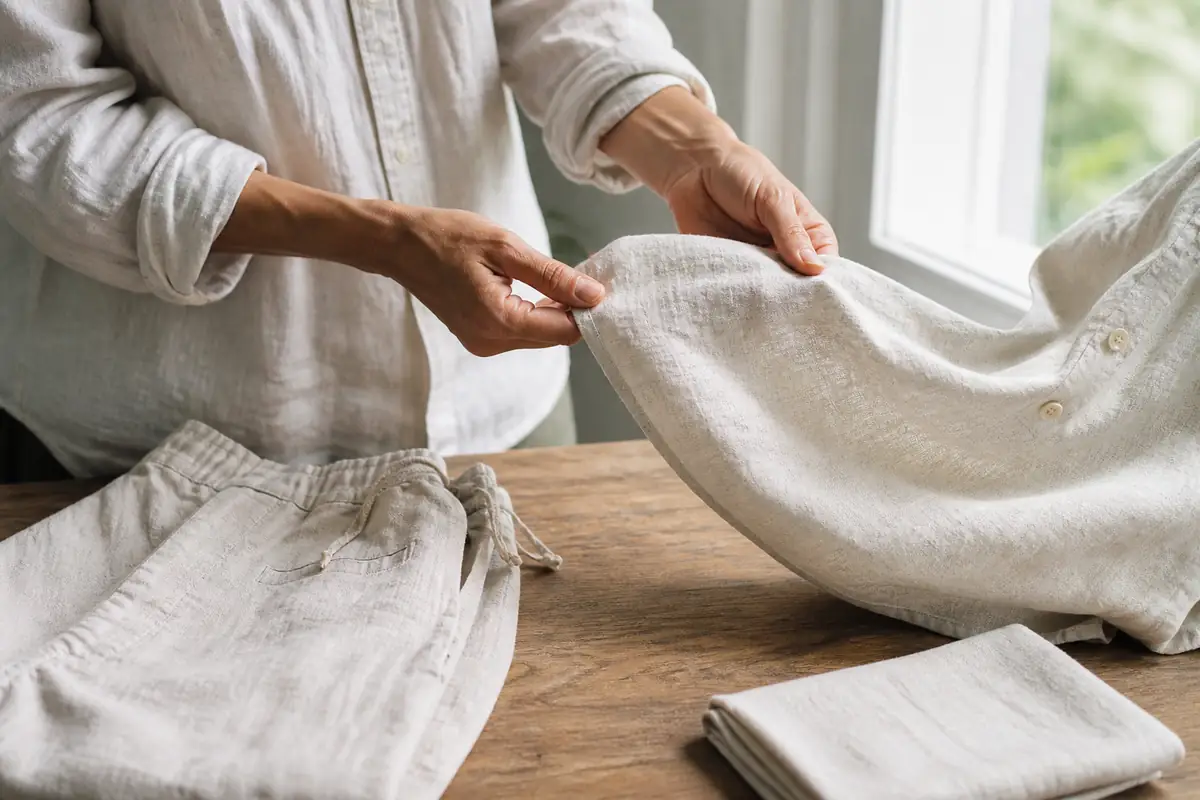
Buy the finished garment, not the romance of the fibre
For shirts and loose dresses, look for an even weave, enough density for the intended coverage, sensible seam allowance and room for movement. Trousers need stronger scrutiny at the seat, knees, pockets and zip. Read the exact fibre percentages and care label: a linen-viscose or linen-cotton blend can behave very differently from pure linen, and “washed linen” does not guarantee zero further shrinkage.
This is a linen-specific fitting and care guide. For a wider comparison of common fibres by garment use, read our cotton, viscose and polyester guide; for percentages and blend labels, use the fabric-composition explainer.
Weight and density decide more than season
Light linen can feel airy and drape softly, but may be transparent, fragile at seams or prone to sharp creasing. Medium weights often balance coverage and movement for shirts, dresses and relaxed trousers. Heavier linen can support jackets, overshirts and structured trousers, though it may feel warm and take longer to dry.
A retailer may not publish grams per square metre, so use observable evidence. Zoom can show weave but not reliably show opacity. Read whether the item is lined, inspect customer images cautiously, then assess the garment against both front and back light when it arrives. Our fabric weight, opacity and drape guide gives a systematic arrival test.
Inspect these areas in daylight
- Weave consistency, slubs and any gaps that become larger under tension.
- Opacity at pockets, bust, seat and upper thigh.
- Seam allowance and reinforcement at high-stress points.
- Whether a lining changes breathability or cleaning instructions.
- Hem depth and whether the garment hangs evenly.
- How the cut looks after sitting, bending and natural creasing.
Match linen construction to the garment
| Garment | Useful linen character | Inspect closely | Common compromise |
|---|---|---|---|
| Relaxed shirt | Light-to-medium weight with movement | Collar, button strain and shoulder seams | Sheerness or a boxier silhouette |
| Summer dress | Fluid or softly structured weave | Lining, bust seams, hem and sitting opacity | Extra care or visible creasing |
| Trousers | Medium-to-heavy stable fabric | Seat, knees, zip, pockets and seam grin | More weight and slower drying |
| Blazer or overshirt | Dense weave that holds shape | Canvas/lining, lapels and sleeve pitch | Warmth and professional cleaning |
| Loose knit | Breathable open structure | Snagging, recovery and shoulder stretch | Less crispness and potential distortion |
Weave, slubs and softness need context
Slubs—small variations in yarn thickness—are common in linen and can form part of its texture. They are not automatically defects. Distinguish a stable irregular yarn from an open gap, broken thread or pull that weakens the cloth. An extremely open weave at a fitted seam deserves caution even if the surface looks attractive.
Very soft linen may have been washed or finished, blended with another fibre, or made from fine yarn. Softness does not prove durability, and crispness does not prove poor quality. Ask what the garment must do. A relaxed holiday shirt can tolerate movement and rumpling that would undermine a sharply tailored work jacket.
Pure linen and blends solve different problems
Linen-cotton blends can combine linen texture with cotton’s familiar handle and may soften creasing, depending on percentages and construction. Linen-viscose blends often add drape, but wet handling and dimensional stability still depend on the exact fabric. Linen-polyester blends may improve recovery and drying while changing handle and heat behaviour.
Do not let a product title imply more linen than the label shows. UK textile rules require fibre composition information, and the CMA says fashion claims should be clear and specific. Check the percentage and separate shell from lining. “Linen look” may describe appearance rather than fibre; only the composition resolves that ambiguity.
Shrinkage is a purchasing risk to manage, not guess
Plant-fibre fabrics can change dimension during washing and drying, but no universal shrinkage percentage applies to every linen garment. Manufacturing, prewashing, weave, finish and care affect the outcome. If the maker declares potential dimensional change, include it in fit decisions. Do not deliberately size up without evidence; extra width does not solve lost sleeve or rise length predictably.
Never wash an uncertain size merely to “see what happens” while expecting a change-of-mind return. Try on indoors with labels attached, photograph the fit and inspect the care instructions first. The clothing-care before first wear guide helps preserve condition and evidence.
Fit linen for movement and its natural crease pattern
A close cut places more tension across open weave and makes crease lines prominent. Sit, walk, reach and bend. Check whether a trouser waistband stays comfortable, the crotch has enough length and pockets lie flat. On shirts and dresses, watch button strain and sleeve mobility. A small amount of ease can let linen hang rather than pull.
Creasing is characteristic, but it should not disguise poor pattern cutting. Twisted side seams, a dipping hem or persistent pulling from one point are construction issues. Use our clothing-quality checklist for seams, reinforcement and alignment, and the women’s size-chart guide when retailer measurements differ.
Care labels turn a beautiful item into a realistic one
GINETEX explains that the wash-tub number is a maximum temperature and bars underneath require milder mechanical action. Linen may be machine washable, hand washable or professionally cleanable depending on the finished garment. A lining, interfacing, dye or trim can make the whole item more delicate than the main fibre suggests.
Use the specified cycle and detergent, avoid overloading and reshape only as instructed. High heat can increase dimensional change or set deep creases. Do not tumble dry unless the symbol permits it. If ironing is allowed, the dot system sets the temperature category; steam suitability still depends on the garment. Our care-symbol guide covers washing, bleaching, drying, ironing and professional care.
Plan for creases without fighting the fabric
Hang or fold according to garment structure and storage space. A lightly misted garment may relax on a hanger if the care instructions permit, while a structured blazer may need professional pressing. For travel, roll loosely or pack around other items rather than forcing sharp folds, then allow time for the garment to hang.
Do not buy a linen suit for a zero-crease requirement. Conversely, do not assume all rumpling looks intentional: clean fit, stable seams and an even hem make natural creasing look considered. The right question is whether you like the garment after an hour of real movement, not only when freshly pressed.
Use an arrival-to-keep checklist
- Confirm fibre percentages for shell and lining.
- Compare colour and opacity in normal daylight.
- Inspect weave, seams, buttons, zip, pockets and hem.
- Try on with the intended underlayers and shoes.
- Sit and move long enough to reveal pulling and crease pattern.
- Read every care symbol and calculate drying or cleaning effort.
- Keep only when fit works before relying on hypothetical shrinkage.
If the retailer’s description is vague or the seller unfamiliar, use our online-shop checklist before ordering and the UK returns guide before altering or washing.
You value its specific handle and accept care and creasing
The weight, opacity and cut suit the garment, and the label fits your laundry or cleaning routine.
Drape, recovery or easier care matters more than purity
Check exact percentages and behaviour; a well-designed blend can be the more durable and wearable choice.
Balanced verdict
Good linen clothing is defined by a suitable weight, stable construction and honest care demands—not by 100% on a product title. Pure linen can be excellent when its texture and creasing fit the job. Blends can add drape or recovery without being inherently inferior.
Inspect in daylight, fit for movement, treat shrinkage as product-specific and reject a care regime you cannot sustain. The best linen item is the one you still like after it has been sat in, washed as directed and worn without constant correction.
Check current official information:
GOV.UK textile labellingGOV.UK product labelling lawGINETEX care symbolsCMA fashion environmental-claims guidance
Frequently asked questions
Does all linen shrink?
No fixed outcome applies. Fabric manufacture, finishing and care differ. Follow the label and any product-specific dimensional-change statement.
Is heavier linen always better?
No. It can improve coverage and structure but may feel warmer and dry more slowly. Match weight to the garment and use.
Are slubs a fault?
Normal yarn irregularity can be characteristic. Broken threads, holes or unstable gaps are different and should be inspected.
Should I size up in linen?
Not automatically. Choose a cut with appropriate ease and follow product-specific fit and shrinkage information rather than guessing.
Can linen go in a tumble dryer?
Only when the exact garment’s care symbol permits it. Fibre name alone does not authorise tumble drying.
Is a linen blend poor quality?
No. Blends can deliberately add drape, softness, recovery or easier care. Judge percentages, construction and finished performance.
How we researched this guide
Recommended Today reviewed current UK textile-labelling requirements, CMA fashion-claims guidance and GINETEX care-symbol information. We assessed linen as a garment system: composition, weight, weave, construction, fit, care and return reversibility.
Limitations
We did not laboratory-test a named fabric or predict individual shrinkage. Product construction and directions change; verify the exact label on purchase and publication day. The original featured image shows generic unbranded linen garments and weave inspection without tag, logo, price, package or copied design. Links are editorial and non-affiliate.