Levi’s 501 vs 505 UK: fit, fabric and the exact product code
The 501 and 505 names hide different variants. Compare two stated UK product references, the fastening, thigh description, fabric and a return-safe fitting plan.
In this guide
Choose the jeans by the product code
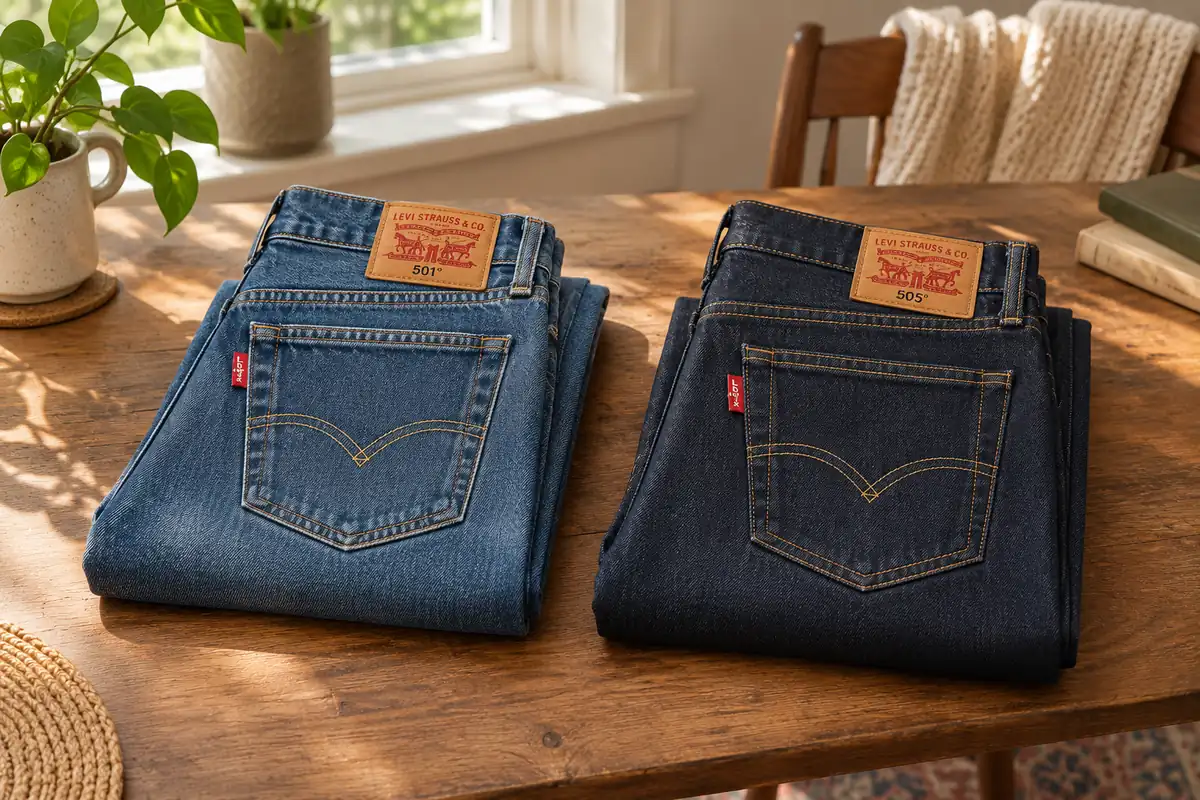
The checked men’s 501 Original 005014020 and 505 Regular 005051447 are straight-leg cotton-blend jeans with a stated 1% elastane or spandex content. The useful starting difference is the button fly on the 501 versus the zip fly on the 505, alongside different thigh descriptions. Neither model number guarantees your fit. Compare the exact wash, dimensions and return route before deciding which pair deserves an indoor try-on.
A shop’s “501” result can contain Original, Loose, Relaxed, cropped and other versions. This comparison concerns the two UK product references above, checked on 22 November 2026. It does not transfer their fabric information to every pair carrying the same three-digit family name. Our broader Levi’s UK retailer profile explains the direct-shopping route; this page answers the narrower question of choosing between these two jeans.
The published construction differences
| Decision point | 501 Original: 005014020 | 505 Regular: 005051447 | What it changes |
|---|---|---|---|
| Fly | Buttons | Zip | Fastening preference and how easily you operate it |
| Thigh description | Regular through the thigh | Extra room in the thigh | A reason to compare room, not proof that one size transfers |
| Waist position | Described as sitting at the waist | Described as sitting at the waist | Check the actual rise against a pair that works |
| Leg | Straight; no matched opening measurement established in this check | Straight; page displays both 16.5-inch and 16-inch opening values | Ask for clarification before treating either figure as an exact comparison |
| Checked composition | 99% cotton, 1% elastane; Milwaukee Blue | 99% cotton, 1% spandex; Dark Rinse | The blend does not measure stretch force or recovery |
| Variant boundary | This full product reference and wash | This full product reference and wash | Another wash or sub-line needs a fresh specification check |
These are manufacturer descriptions rather than measurements we obtained from garments. The current 505 page displays a 16.5-inch opening and a separate 16-inch opening in its fit information, with measurements described as based on size 32. We cannot reconcile those two figures by guessing. Ask for the measurement applicable to your precise size; meanwhile, neither number establishes how its seat, front rise or thigh compares with the selected 501.
Translate thigh room into a fitting question
The strongest reason to investigate the 505 is a specific need for more thigh space while retaining a straight lower leg. The strongest reason to investigate the 501 is that its documented block and button fastening already match your brief. “Regular” is not a measurement unit, and extra fabric in one area does not ensure a better waist or seat. Record the problem you are trying to solve before comparing photographs.
Use a comfortable pair from your wardrobe as a reference. Fasten it, lay it flat without stretching, and record the waist, rise, thigh and inseam using one consistent method. A doubled flat waistband is not the same thing as a retailer’s body-waist chart. Our jeans measurement guide explains the distinction so that a body measurement is not accidentally compared with a finished garment width.
A focused fitting note
- Describe one current problem: thigh restriction, waistband pressure, an uncomfortable rise or excess seat fabric.
- Compare that area first, then check the remaining measurements and preferred length.
- Try sitting, walking and bending indoors while labels remain attached.
- Reject a pair that only works when the fastening is loosened or the waistband is pulled into an unnatural position.
A cotton-blend pair may change during wear and washing, but that is not a reliable correction for a clearly unsuitable purchase. We have not measured relaxation or shrinkage in either reference. Both checked versions list a small stretch-fibre component, yet that percentage does not quantify stretch force, recovery or comfort during movement. Restart the fabric check whenever you select another wash.
Buttons and zips are a use choice
The fly is a practical difference you can assess without accepting a heritage story. Consider finger movement, dressing speed, how easily you locate the fastening and whether you can use it comfortably with the waistband positioned correctly. A preference for a zip is sufficient reason to shortlist the 505; a preference for buttons can favour the 501. Neither fastening by itself proves a longer garment lifespan.
Inspect the surrounding stitching and the fabric around each attachment during an eligible try-on. Look for a zip that catches, a buttonhole that is difficult to operate or uneven tension around the fly. Our clothing construction checklist provides a wider inspection method. These checks identify an issue with the pair in front of you, rather than declaring every garment in a model family good or bad.
Fabric and wash can change the result
The two checked compositions are useful because both list 99% cotton and 1% stretch fibre; elastane and spandex are terms used for the same fibre category. That does not establish identical yarn, finishing, fabric weight or hand feel. Another 501 or 505 can be rigid cotton instead, so attributing every difference to the three-digit fit number would ignore a material change.
Read the item-specific label and care instructions when the parcel arrives. If the seller supplies a different composition from the listing you saved, pause before removing labels or wearing it outside. The fabric composition explanation helps distinguish a stated fibre blend from broader claims about breathability or strength. For after-delivery movement and care decisions, use the separate indoor denim fit and ownership guide.
Compare the cost of a successful pair
At the live check on 22 November 2026, the selected 501 page displayed £100 and said the item was excluded from promotions; the selected 505 displayed £56 against an £80 reference price, with further offer wording. These were page-level observations before selecting an available waist and length, not a confirmed delivered quote. Write down the actual size price, promotion eligibility and delivery charge at checkout before treating the gap as a saving.
For a transparent planning example, a £20 premium spread over 100 actual wears would add 20p per wear before care or repair. That is arithmetic, not a claim that either model costs £20 more today or will last for 100 wears. Use the cost-per-wear method with your own realistic frequency, and avoid justifying a doubtful fit through an optimistic lifespan.
The model decision and the seller decision belong together, but they are different questions. Once you have chosen a reference, our Levi’s versus Zalando comparison for buying the same jeans shows how to compare the brand’s direct route with a multi-brand order. Keep the full code and composition fixed while checking that transaction.
Which pair deserves your shortlist?
Start with the 501 Original
Choose this route when the checked straight-leg block looks compatible with your reference measurements and you specifically prefer a button fly. Confirm the exact wash and reject an unsuitable seat or rise during the permitted indoor inspection.
Investigate the 505 Regular
Choose this route when zip operation and the published extra-thigh-room description address a clear requirement. Verify that the waist, rise and leg still work; additional room in one place does not compensate for a different problem elsewhere.
Our balanced verdict is that the 505’s fastening and thigh description make it a meaningful alternative to investigate, rather than an automatic upgrade over the 501. A successful purchase is the correctly identified pair that fits your routine and can be returned if it does not. A fit number is the beginning of that decision, not its conclusion.
Manufacturer evidence for this comparison
Levi’s GB 501 Original product reference 005014020Levi’s GB 505 Regular product reference 005051447Levi’s UK online return and exchange instructions
Questions about these two jeans
Are all 501 and 505 jeans made from rigid cotton?
The currently selected references contain 1% stretch fibre alongside cotton. Other washes can have another composition, so check the full code rather than applying one blend to the family.
Which 505 leg-opening figure should I use?
The checked page contains two different opening figures. Obtain clarification for the actual size instead of selecting whichever number makes the comparison look simpler.
Should I automatically buy a smaller waist in the 505?
A different thigh description does not establish a waist-size conversion. Start with the relevant chart and your measured reference pair.
Is a button fly evidence of better construction?
Fastening type alone is insufficient to judge workmanship. Inspect stitching, attachment security and comfortable operation on the actual garment.
Can I wash the jeans before deciding whether to keep them?
Washing changes the purchase condition and may affect a preference-return route. Finish the eligible indoor assessment first and follow the specific seller’s instructions.
How we compared the 501 and 505
Recommended Today compared the two named GB product references and the brand’s UK return instructions on 22 November 2026, then translated the published differences into an original fitting and cost decision. We compared the proposed subject with the site’s existing and scheduled jeans material to keep this page focused on model selection.
Limitations of this jeans analysis
Our team has not worn, washed, weighed or laboratory-tested these pairs. No independent claim about shrinkage, durability or all-day comfort follows from this research. Size stock, selling prices, fabrics and seller terms can change; a different product code requires its own check.