Choosing everyday denim: rise, cut, stretch and washing
A familiar waist number does not guarantee the same fit. Compare garment measurements, rise, thigh room, denim composition and recovery before colour or trend.
In this guide
Choose the pair that stays comfortable after movement
Start with a well-fitting pair you own, record its garment measurements, then compare the new jeans across waist, rise, hip, thigh, knee and inseam. Test sitting, stairs and pockets indoors. Stretch can improve comfort, but only good recovery stops the fabric relaxing into a different size.
Jeans combine a shaped garment with a fabric that can soften, relax and shrink differently by construction and care. Retail size is only the search filter. A reliable decision uses the exact product chart, the wearer’s preferred position on the torso, the rigid or stretch composition, the wash and the alteration limit.
Translate the product page into measurements
| Evidence | What to record | Why it changes fit |
|---|---|---|
| Waist | Flat garment width and body position | A high waist and low waist meet different circumferences. |
| Front and back rise | Crotch seam to waistband | Controls torso coverage, seat room and waistband position. |
| Hip and thigh | Widths at stated points | Prevents sizing up solely to solve upper-leg pressure. |
| Knee and hem | Opening widths | Separates straight, tapered, bootcut and wide silhouettes. |
| Inseam | Crotch to finished hem | Determines break, footwear interaction and alteration. |
| Composition | Every fibre percentage | Signals structure, stretch and care, not exact performance. |
Measure a garment, not only your body
Body measurements help choose a range, while a trusted pair shows the fit you actually like. Fasten it, lay it flat without stretching and measure consistently. Record waistband across, front rise, hip at a repeatable distance below the waist, upper thigh, knee, hem and inseam. Double flat circumferences only where the retailer uses the same method.
Product charts may show body dimensions, finished garment dimensions or a mixture. Read the heading and method before comparing numbers. If the chart omits rise or thigh, ask the retailer in writing rather than converting a model’s height into certainty. Our clothing size-chart guide explains why labels are not measurements.
Choose rise by where the waistband should sit
Rise is not simply a style label. The front rise influences the height at the abdomen; the back rise must also cover the seat during sitting and bending. A pair can feel loose at the standing waist yet pull down because the rise or seat curve is too short. Conversely, excess rise can fold or create fabric at the front.
Wear the intended base layer and mark the preferred waistband position on your body. Compare that circumference with the garment, then check whether the front and back rise can reach it without pulling. Belts can stabilise a suitable waist; they cannot correct a short rise, strained fly or distorted pockets.
Cut describes distribution, not one universal shape
- Straight: compare thigh, knee and hem because “straight” may still taper.
- Slim: require enough calf and knee room for sitting and stairs.
- Relaxed: distinguish intentional ease from a waistband that is simply too large.
- Bootcut: test the flare with the heel height and shaft actually worn.
- Wide: check full hip release, drape and floor clearance rather than hem width alone.
- Cropped: verify the finished inseam on your leg; model photographs are not a ruler.
Read stretch as a system
Cotton-rich rigid denim can mould with wear but usually offers little immediate give. A small elastane proportion can support movement, yet percentage alone does not reveal stretch direction, fabric weight or recovery. Two fabrics with the same label can behave differently because yarn, weave, finishing and panel direction differ.
Recovery matters as much as extension. Indoors, sit for several minutes, climb stairs and bend, then stand and inspect the knee, seat and waistband. Fabric that remains bagged or requires constant pulling up is unlikely to improve through wishful sizing. Read the full fabric-composition guide before treating one fibre as a quality score.
Check construction where jeans work hardest
Inspect the crotch intersection, pocket corners, belt-loop anchors, fly base and inner thighs. Stitches should be secure without skipped areas, loose chain ends or puckering that changes the shape. Bar tacks can reinforce stress points, but a dense stitch cannot compensate for a strained size.
Turn the hem and pocket bags out gently. Check that seams lie flat, the zip runs without catching and rivets or buttons have no sharp edge. Wash effects may intentionally abrade high points; compare whether distressing crosses a structural seam. Use our clothing-quality checklist for the wider inspection.
Use an indoor fit sequence before removing tags
Fasten the jeans without holding your breath or pulling the waistband into place. Sit upright and slouched, raise each knee, squat only as far as normal life requires, use the pockets and walk in the intended shoes. Look for horizontal strain lines, a fly that opens, pocket flare, waistband gaping and hems that catch under footwear.
Test the waist after movement, not only at the mirror. If sizing down is proposed because stretch denim may relax, ensure the smaller pair does not distort seams or restrict circulation now. If sizing up solves thighs but creates a large waist, compare a different cut before budgeting for alteration.
Expect colour and wash to affect the comparison
Two colours sold under one style name may not behave identically. Dye, surface treatment, abrasion and production variation can change handle, stretch and dimensions. Treat each colour as an exact variant: check its composition, chart, care and reviews rather than transferring the verdict from a black pair to a blue pair.
Strong fading at whiskers, knees and seams may be intentional, but it can also remove material from high-stress areas. Inspect whether decorative abrasion reaches pocket corners or the inner thigh. A raw or dark finish may transfer colour; a heavily washed finish may already feel soft without predicting long-term strength.
When ordering two sizes for comparison, keep packaging and product codes separated and return each pair through the correct order. Photograph labels privately before try-on so a similar colour does not cause a stock or refund mismatch.
Recheck the chosen pair in daylight before removing tags, because indoor light can hide dye transfer, abrasion and surface marks.
Plan alterations before purchase
Shortening a plain hem is often predictable, but tapering, changing rise, reshaping hips or preserving a distressed factory hem can be more involved. Ask an alteration professional what is realistic before the return window closes. Include the quote in the kept cost and keep the garment unaltered until the decision is final.
Shortening changes where a taper or flare meets the leg. Pin the proposed length evenly, add the intended shoes and view front, side and back. A low sale price is not value if proportion is lost after hemming. Compare the result through our cost-per-wear framework.
Wash for the exact fabric and finish
Follow the sewn care label, empty pockets, close fastenings where instructed and wash with compatible colours. Turning jeans inside out may reduce surface abrasion, but it does not override temperature or detergent guidance. Dark indigo can transfer dye, especially when new, so keep it away from pale upholstery and footwear until behaviour is understood.
High heat can change fibres, stretch components, colour and leg twist. Air-dry only when the label allows and reshape without pulling seams. Do not postpone necessary cleaning simply to preserve appearance; choose a finish compatible with realistic care. Our care-label explainer decodes common symbols.
Which denim route fits the need?
Structure and stable shape are priorities
The rise and thigh fit without relying on give, the wearer accepts a firmer break-in and the care routine suits the finish.
Movement needs measured flexibility
The fabric recovers after sitting, seams remain straight and the exact composition and care are acceptable.
Balanced verdict
The strongest everyday jeans are the pair whose garment measurements match a proven fit and whose fabric returns to shape after normal movement. Choose rise before styling details, solve thigh and seat room through cut, and price alterations before keeping the pair.
Build outfits with the UK capsule-wardrobe guide, verify online return rights, and browse more Fashion guidance or the shop directory.
Check current official guidance:
GOV.UK textile labelling ↗GOV.UK returns and refunds ↗GOV.UK product labelling ↗
Frequently asked questions
Should jeans feel tight because they will stretch?
No universal amount is safe to assume. They should allow normal movement now; judge relaxation and recovery in an indoor try-on.
What measurement matters most for jeans?
No single number does. Waist position, rise, hip, thigh and inseam work together.
Does more elastane mean a better fit?
No. It may add stretch, while construction and recovery decide whether shape remains stable.
Can every pair be shortened easily?
Not without changing proportion. Tapers, flares and special hems need assessment before purchase.
How often should jeans be washed?
Follow the care label and hygiene need. There is no responsible universal interval for every fabric, use and household.
Methodology and limitations
We assessed everyday denim through garment measurement, rise, cut, composition, movement, construction, alteration and care. Official UK textile, labelling and returns guidance was checked on 29 August 2026. No named jeans were wear-tested.
Limitations
Fit is individual and fabric behaviour varies by exact production run and care. Recheck the product chart, sewn label, return window and alteration advice before purchase.
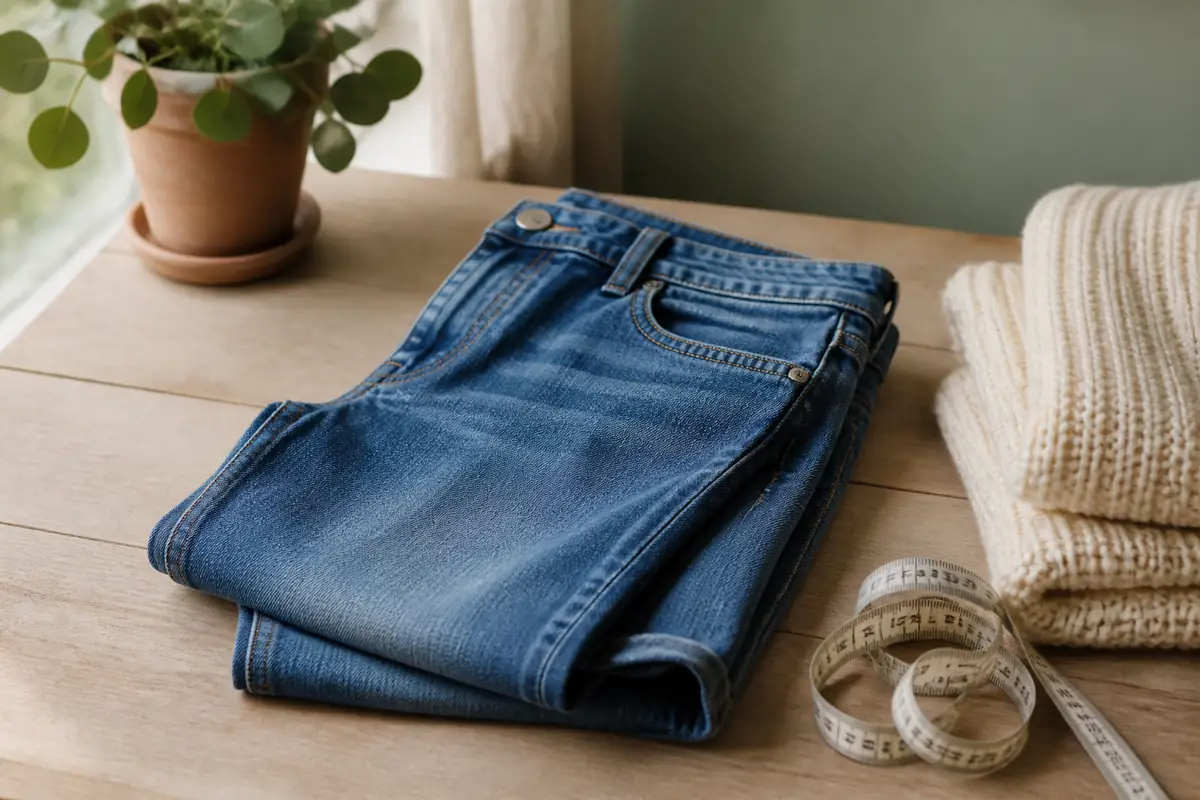
The image is an editorial illustration, not a photograph from a product test. Links are editorial and non-affiliate.