Bean-to-cup coffee machines ownership guide: beans, filters, descaling and service
A bean-to-cup machine stays understandable when daily rinsing, milk hygiene, water settings, filter changes, descaling and faults are recorded against the exact manual—not improvised from another model.
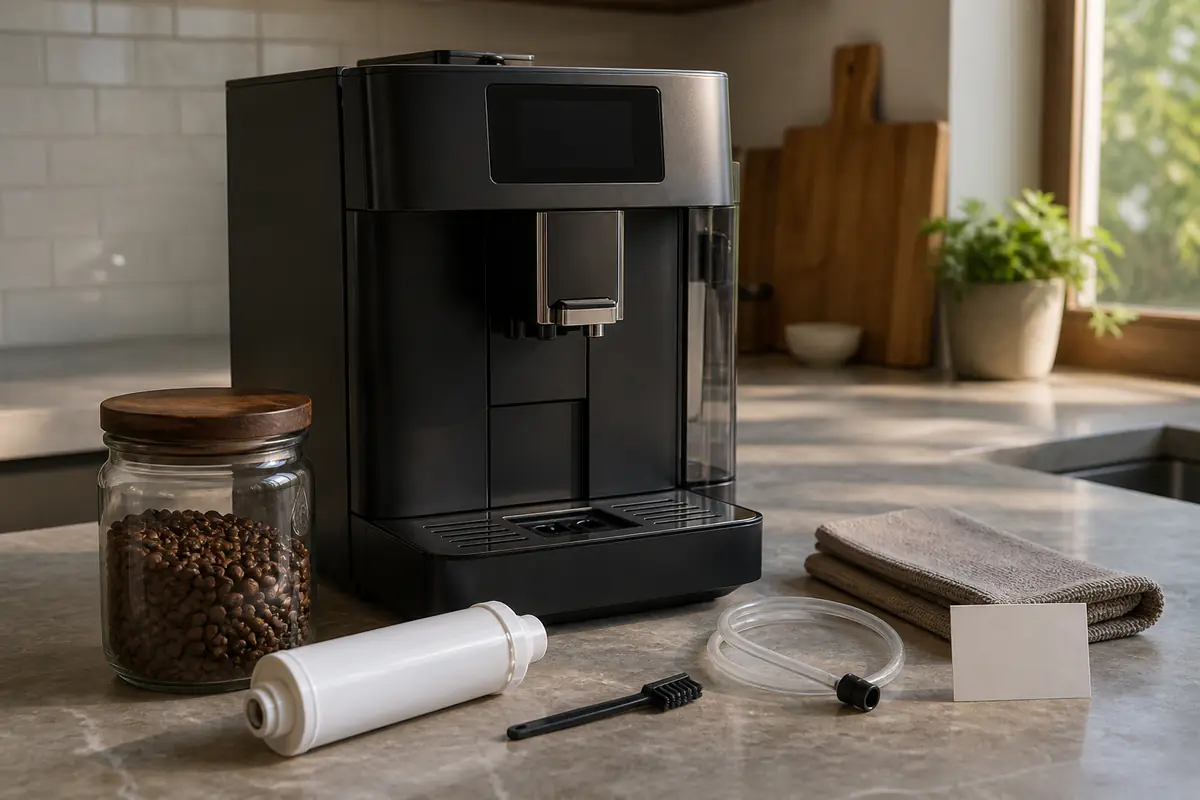
In this guide
Follow the exact machine, water and milk-path instructions
Use suitable beans, fresh water, prompt milk cleaning and the manufacturer’s specified care cycles; stop after electrical or abnormal mechanical symptoms and preserve the model and error evidence for service. Our bean-to-cup buying guide covers selection, while the value guide models ongoing cost.
This article is the operating layer: how to keep one known machine clean, traceable and serviceable after purchase. Frequencies below are decision points, not universal schedules; the manual and machine prompts control the exact procedure.
| Area | Routine evidence | Escalation trigger | Wrong shortcut |
|---|---|---|---|
| Beans and grinder | Bean type, setting, output | Jamming, new noise, no grind | Changing while idle if prohibited |
| Milk path | Cleaned after use, parts dried | Persistent residue, smell, blockage | Leaving milk in warm components |
| Water and scale | Hardness, filter, prompt date | Repeated prompt, poor flow, leak | Vinegar or unapproved chemical |
| Service | Model, serial, error, history | Electrical symptom or unresolved fault | Opening the mains appliance |
Keep one machine care log
- Model, serial, purchase record and exact manual.
- Water-hardness result and configured machine setting.
- Bean type and any manufacturer exclusions.
- Daily rinse, drip tray and grounds-container observations.
- Milk-system cleaning and refrigeration handling.
- Filter installation and replacement date.
- Descale prompt, approved product and completed rinse.
- Error code, symptom, service case and parts outcome.
Start with the exact manual and model identity
Two machines from the same brand can use different removable brew units, filters, milk systems and cleaning products. Save the manual for the exact suffix and photograph the rating label while accessible.
Use our product-manual guide if the paperwork is missing. A video for a similar fascia is not enough to authorise disassembly or a chemical.
Set water hardness before trusting prompts
Manufacturer care guidance commonly uses the configured water hardness to calculate descaling prompts. Test as the manual specifies or obtain current local water information, then record the setting and date.
A water filter may reduce scale exposure but does not erase cleaning or descaling duties. Its compatibility, activation, replacement and any reset step remain model-specific.
Use beans the grinder is designed to handle
Check the manual for exclusions. Some manufacturer guidance warns against very oily, caramelised or coated beans because residue can affect the grinder. Store beans dry, dark and sealed without filling months of stock into the hopper.
When testing a different roast, change one variable and allow the machine to clear the previous beans. Do not attribute a slow or weak drink to the beans until grind, dose, water, temperature and cleanliness are considered.
Adjust the grinder only when the instructions permit
Some automatic grinders should be adjusted only while actively grinding and in small steps. Follow the exact manual and wait for the stated number of drinks before judging the result.
Never force a dial, reach into the hopper near moving parts or use a tool to free a jam while connected. An abnormal motor sound or repeated failed grind is service evidence, not a cue for deeper home access.
Manage the daily water and grounds cycle
Use fresh potable water as directed, empty the grounds container and drip tray before overflow, and clean sensors or contact areas only by the approved method. Record unexpectedly wet grounds, excess rinse water or rapid tray filling.
Automatic rinse water is part of operation, but a sudden change can reveal a setting, blockage, seal or fault. Compare with the manual rather than blocking outlets or disabling cycles.
Clean milk paths immediately after use
Milk residue becomes harder to remove and can affect hygiene and texture. Run the machine’s specified clean function, wipe a steam wand as directed, and dismantle carafe parts only to the extent the manual permits.
Refrigerate milk and any approved filled carafe according to instructions. A self-clean label does not necessarily replace removal, rinsing, drying or periodic detergent steps.
Keep removable parts separate from electrical parts
Brew units, trays, tanks and carafe pieces may have different water, detergent and dishwasher rules. Lay them out in order, inspect seals and let required components dry before refitting.
Do not immerse the machine, wash non-approved components in a dishwasher or apply lubricant unless the exact official procedure names the material and location.
Descale when the machine and manual require it
Use the specified descaler concentration, container size, sequence and rinse. Start only when there is enough uninterrupted time and ventilation to finish; pausing mid-cycle can leave solution inside.
Manufacturer guidance may expressly reject vinegar or unsuitable descalers. “Natural” is not evidence of material compatibility, correct concentration or complete removal.
Record filters as consumables, not permanent protection
Write the installation date and machine counter reset, and keep the compatible part reference. Replace when prompted or according to the exact conditions; an old filter can become another source of poor flow or taste.
If the household changes water source, retest the hardness and review the setting. Do not stack unofficial filters or add substances to the tank to chase taste.
Investigate taste with a controlled sequence
Clean the milk path, brew unit and outlets, confirm water freshness, then hold dose and drink recipe steady while changing one bean or grind variable. This separates maintenance from preference.
Do not run repeated unwanted drinks simply to “flush” uncertainty. Record accepted yield and waste using the value guide, and stop if a taste change coincides with burning smell, leaks or abnormal noise.
Treat leaks by location and timing
Photograph the cold unplugged machine, note whether water appeared during fill, rinse, brew, milk clean or idle time, and check only user-removable components for correct seating.
Water near the plug, cable or electrical body requires immediate disconnection when safe and an appropriate service route. Moving the machine and repeating the cycle can obscure the source or spread damage.
Preserve error codes before resetting
Photograph the exact message or indicator pattern, time, drink stage and recent maintenance. Follow only the reset or obstruction checks in the manual; repeated resets can erase useful context without fixing a cause.
Use our warranty evidence guide to keep the order, serial, care log and service case together. Do not invent an internal diagnosis.
Stop after electrical or severe mechanical symptoms
Sparking, smoke, odd smells, tripping, cable damage, unusual heat, grinding impacts or persistent leaks require stop-use action. Unplug when safe and contact the retailer, manufacturer or qualified repair route.
Our recall action guide explains how to match safety alerts. Never sell or donate an unresolved suspect machine.
Ask service providers for a defined scope
Provide model, serial, symptom, error, care history and proof. Ask whether diagnosis, collection, parts, electrical testing, return carriage and repair guarantee are included, and what happens if parts are unavailable.
A fixed fee is only comparable when the scope matches. Keep replaced-part and test records, and use the faulty-goods guide where seller remedies may apply.
Review the machine after every service event
Confirm that tanks, trays, brew unit and cable are intact and that the invoice matches the agreed work. Retain any revised care instruction and re-enter filter or hardness settings if the service reset them.
Run only the authorised recommissioning sequence. If the original or a new abnormal symptom appears, stop and reopen the case rather than normalising it as the price of ownership.
Use the log to improve the next purchase decision
After several months, total accepted drinks, wasted beans and milk, filters, chemicals, time and service. This evidence shows whether the machine’s convenience matches the household rather than an imagined user.
If ownership is consistently burdensome, a simpler coffee method may be the better next choice. Do not keep an unsuitable machine in service merely because its initial purchase was expensive.
Maintain at home or book service?
The task is explicitly user-accessible
The manual names the removable part, compatible consumable and complete safe procedure, and no abnormal electrical symptom is present.
The fault exceeds routine access
There is electrical risk, a persistent leak, grinder fault, unavailable part, repeated error or a procedure the manual reserves for service.
Balanced verdict
Reliable bean-to-cup ownership is a recorded maintenance system, not occasional descaling after taste goes wrong. Match beans, water, filters, milk care and service to the exact model, and preserve error evidence before interventions.
Use the linked buying, value, manual, warranty, recall and faulty-goods guides.
Official checks:
De’Longhi UK coffee-machine care example ↗
De’Longhi bean-to-cup cleaning example ↗
Electrical Safety First appliance checks ↗
UK product safety alerts and recalls ↗
Frequently asked questions
Can I descale a bean-to-cup machine with vinegar?
Only use the chemical and concentration allowed by the exact manufacturer instructions. Some manufacturers explicitly warn against vinegar.
Does a water filter remove the need to descale?
No — It may affect frequency, but follow the configured hardness, filter replacement and machine prompt for the exact model.
When should the grind setting be changed?
Only as the exact manual directs; some grinders should be adjusted in small steps while they are actively grinding.
Can a milk carafe stay in the fridge between drinks?
Follow the exact carafe and food-hygiene instructions. The machine clean cycle may not replace dismantling, rinsing and periodic cleaning.
What evidence helps a repair request?
Model, serial, purchase proof, error image, symptom timing, recent maintenance, water setting, consumables and previous case numbers.
Methodology and limitations
We separated day-to-day ownership from existing buying and value articles, then assessed beans, water hardness, filters, brew and milk cleaning, descaling, symptom capture and service scope. Current manufacturer and Electrical Safety First resources were checked on 2 September 2026. We did not operate, dismantle or repair a machine.
Limitations
Maintenance varies materially by model, water, milk system and manufacturer. This is not an electrical repair procedure or food-hygiene certification. Follow the exact manual and recheck official support before purchase.