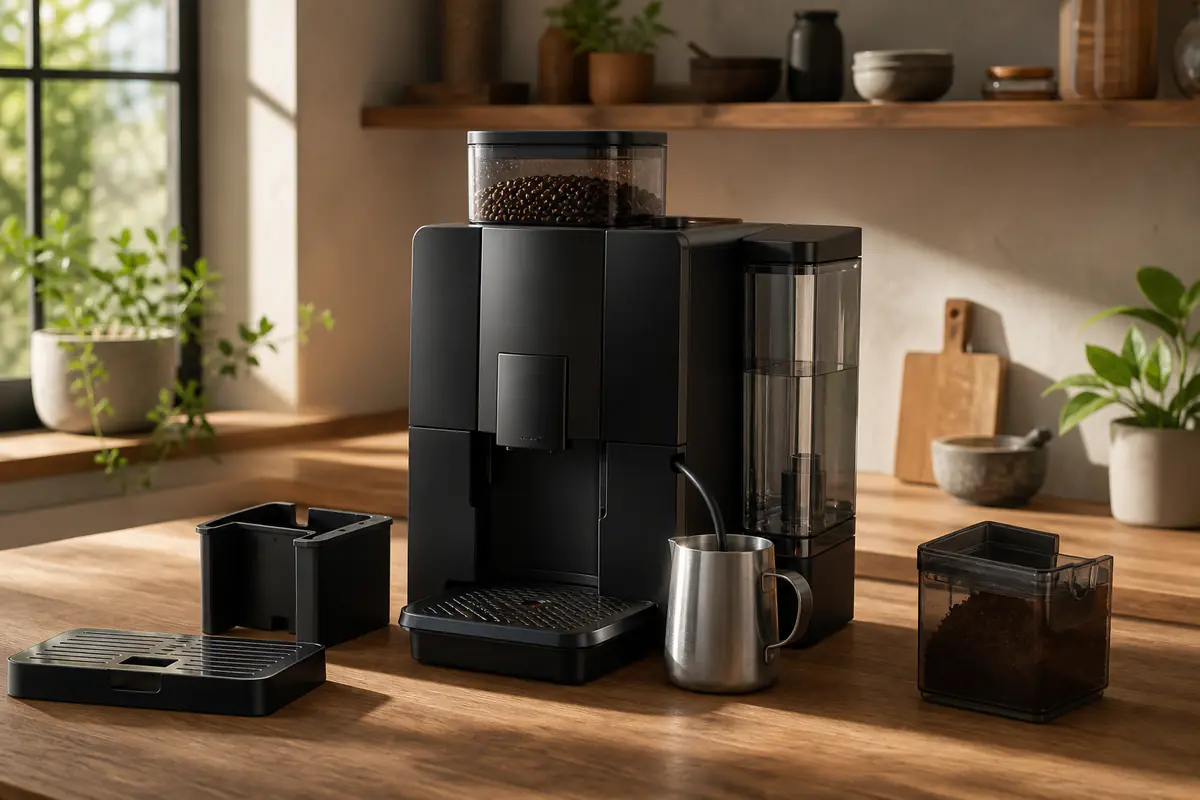
Bean-to-cup coffee machines: grinder, milk system, controls and cleaning
A long drinks menu cannot compensate for an awkward grinder, inaccessible brew unit or milk circuit that the household will not clean. Map daily work before buying.
In this guide
Choose the maintenance system as carefully as the drinks
A suitable machine matches the household’s coffee, milk and cleaning routine and provides accessible official instructions and parts. Do not buy by pressure figure, touchscreen size or recipe count alone.
Use our specification guide, appliance running-cost guide and warranty-registration guide to compare exact UK models.
| System | Evidence to collect | Hidden work | Decision test |
|---|---|---|---|
| Grinder | Burr type, settings, adjustment rule, bypass | Bean changes and purging | Can it be adjusted safely? |
| Milk | Steam wand or removable carafe | Immediate rinse and thorough cleaning | Will every user clean it? |
| Brew path | Removable or service-only unit | Rinsing, drying and refitting | Is access documented? |
| Water | Tank, filter, hardness setting, descale routine | Consumables and downtime | Does the routine fit local water? |
Record the complete ownership system
- Exact UK model and revision.
- Machine dimensions with service-door clearance.
- Bean hopper and grinder adjustment instructions.
- Water tank, drip tray and grounds-bin access.
- Milk path parts and after-each-use cleaning.
- Brew-unit access and permitted cleaning method.
- Water-hardness setup, filter and descaler requirements.
- Warranty, repair route and available consumables.
Define the drinks and daily volume first
List the drinks actually made, cup sizes, milk types and busiest period. A household making two black coffees needs a different workflow from one producing six milk drinks before work. Record whether users want one-touch consistency, manual milk control, decaffeinated bypass and separate profiles.
A recipe icon does not prove the machine can deliver the preferred ratio or temperature. Check adjustable coffee quantity, strength, water and milk settings for the exact recipe. Our review guide can reveal recurring workflow issues, but only the manual establishes permitted operation and maintenance.
Compare grinder control as a process
Record burr type, number and range of settings, hopper design, bypass chute and official adjustment procedure. Some manufacturers instruct users to change the grinder only while it is running; ignoring that can jam the mechanism. Verify the exact manual rather than copying advice between machines.
More settings are useful only when changes are repeatable and the household understands the delayed effect of retained grounds. Oily, flavoured or coated beans can be unsuitable for some grinders. Check official bean guidance, hopper cleaning and whether switching to decaf requires emptying, purging or using pre-ground coffee.
Do not buy by pressure or recipe count
A headline pump pressure does not describe dose, grind, temperature stability, flow or the programmed drink. Compare controls that affect the cup and whether they can be saved without navigating a complex display. A large recipe library can add little if the household uses three drinks.
Ask how the machine handles two cups, tall mugs, hot water and interrupted cycles. The dimensions guide helps include cup clearance, tank removal, bean filling and side-door access rather than checking only the footprint printed on a retailer page.
Choose a milk system the household will clean
A steam wand gives direct control but needs wiping and purging immediately. An automatic carafe may be convenient yet contains tubes, channels, seals and connectors requiring after-use and periodic cleaning. Record which parts detach, which are dishwasher-safe and which cleaner the manufacturer permits.
Milk residue should not remain while the calendar waits for a weekly session. Compare the complete sequence after every drink, at day end and during deep cleaning. If several users share the machine, assign responsibility. The simplest milk system that reliably gets cleaned is better than a sophisticated circuit that becomes a hygiene and performance problem.
Inspect the brew unit and waste path
Determine whether the brew unit is user-removable, how the machine must shut down before removal and whether it is rinsed with water only. Official De’Longhi guidance, for example, warns that shutdown position matters and that detergent can damage certain units. Other models can require authorised servicing instead.
Trace grounds from grinder to puck bin and rinse water to drip tray. Small containers create frequent emptying but oversized damp waste can sit too long. Check access without moving the machine, spill risk, sensor behaviour and whether hidden cavities can be reached with the supplied brush.
Map water hardness, filters and descaling
Local water hardness affects scale formation, but the correct response is model-specific. Check whether a test strip is included, how hardness is entered, which filter fits and what the manual says about replacement. A filter can reduce scale burden but is an ongoing consumable, not permission to ignore prompts.
Record the complete descaling sequence, permitted solution, time, vessel size and rinse cycles. Never assume vinegar is allowed; manufacturers can prohibit it. The water-hardness guide explains why appearance alone is not a schedule and why product instructions remain controlling.
Calculate counter space and service access
Measure width, depth and height with the tank removed, service door open, hopper lid raised and mug placed under the spout. Include cable route, steam clearance and a dry area for parts. A machine that fits under a cupboard only when it cannot be filled or cleaned does not fit.
Check appliance weight if it must be pulled forward daily. Protect sockets and keep the machine on a stable dry surface according to its safety instructions. Electrical Safety First advises correct registration, inspection and maintenance of coffee machines; do not continue using one with leaks, damaged cable, burning smell or abnormal heat.
Price the recurring work and consumables
List water filters, descaler, milk cleaner, lubricants if specified, cleaning brushes, replacement seals and expected service. Add wasted beans during setup and the energy and water used by rinsing. Do not invent a universal annual cost; use the exact manual intervals, local hardness and household volume.
Compare availability from the manufacturer and authorised channels, including model compatibility. A low purchase price can be poor value when proprietary consumables are difficult to identify or the brew unit cannot be serviced economically. The later value guide can compare capacity and running cost after this workflow screen.
Test the interface against real users
Check whether every user can start, cancel and clean a drink without guessing. Icons, touchscreens and profiles can help, but only if prompts are clear and settings do not hide critical tasks. Consider visibility, reach and whether a power interruption leaves parts in a recoverable position.
Read the manual’s error and shutdown sections before buying. Save the PDF and exact model revision. The manual-finding guide helps avoid relying on a retailer summary when multiple machines share a family name but differ in milk system or cleaning access.
Plan the first month of ownership
On arrival, verify the model, accessories and damage before adding beans or milk. Set water hardness, rinse as instructed and start with conservative grinder changes. Record the date, filter and first settings so later adjustments have context.
Create a calendar for immediate milk cleaning, tray and grounds handling, brew-unit care, filter changes and prompted descaling. Register the appliance for safety notices. If the household will not follow that schedule during the first month, return the unused machine within the applicable terms rather than allowing complexity to become neglect.
Check noise, heat and waste-water behaviour
Grinders, pumps and automatic rinse cycles can be disruptive in an open-plan home or during early starts. Look for model-specific evidence about when the machine grinds, purges and rinses rather than relying on a general quiet-mode claim. Confirm where hot rinse water goes and how quickly the drip tray fills during the household’s expected number of drinks.
Automatic shutdown may trigger another rinse, while a milk clean can require a separate vessel and several parts on the draining board. Map those steps into the kitchen at the busiest time of day. A machine that produces a good drink but monopolises the sink, bin or worktop can be the wrong ownership fit.
Verify consumables and repair access before checkout
List the exact water filter, descaler, milk-cleaning product, lubricant and replacement seals authorised for the model. Check pack quantities, replacement intervals in the manual and whether supplies are sold through more than one stable UK route. Do not assume a similarly shaped filter or generic tablet is approved.
Find the UK service contact, warranty exclusions and procedure for a blocked grinder, leaking seal or failed milk system. Ask whether the brew unit, grinder or milk connector is user-replaceable, serviceable or sealed. A lower purchase price can be poor value when routine parts are obscure or the whole machine must travel for a minor repair.
Automatic milk or steam wand?
Repeatability matters and parts will be cleaned
Users want one-touch drinks and will perform immediate rinses, disassembly and periodic circuit cleaning.
Control and a simpler path matter
A user is willing to texture milk manually and wipe, purge and clean the wand after every use.
Balanced verdict
Buy the machine whose cleaning and access routine the household can sustain. Grinder control, milk hygiene, brew-unit access, water hardness and official support matter more than recipe count.
Continue with the linked specifications, running-cost, warranty, reviews, dimensions, water-hardness and manual guides.
Official checks:
Electrical Safety First coffee-machine advice ↗
De’Longhi official machine-care guide ↗
De’Longhi bean-to-cup support examples ↗
UK product safety alerts ↗
Frequently asked questions
Does more pump pressure make better coffee?
Not by itself — Grind, dose, temperature, flow and programming affect the cup; compare the complete system.
Is an automatic milk carafe easier?
It can simplify drinks but adds tubes and parts requiring immediate and periodic cleaning.
Should the brew unit be removable?
Removable access can help care, but follow the exact shutdown and cleaning method; some machines use service-only designs.
Can vinegar descale every machine?
No — Use only the method and solution permitted by the exact manufacturer manual.
How much counter clearance is needed?
Measure with tank, hopper and service doors open and include mug, steam and cable space.
Methodology and limitations
We compared bean-to-cup systems through drinks, grinder, controls, milk path, brew unit, water, cleaning, dimensions, consumables and support. Current Electrical Safety First and official manufacturer care material was checked on 2 September 2026. We did not brew, electrically test or dismantle a named machine.
Limitations
Models, revisions, firmware, accessories, consumables and instructions change. Coffee results depend on beans, water, settings and maintenance. Follow the exact UK manual and safety information; this guide does not replace manufacturer instructions or an electrical inspection.