Sports bra support guide: activity, fit, construction and returns
A useful sports bra controls movement without making breathing, skin comfort or the activity harder. Support labels are only a starting point; construction and fit must work together.
In this guide
Fit the activity and body, not the marketing tier
Start with the highest-impact activity the bra will actually cover and verify the exact construction behind the support claim. A secure band, contained cup area, manageable straps and comfortable movement matter more than a generic low-, medium- or high-support badge.
Begin with the clothing size-chart guide, use the online quality checklist for construction evidence and compare realistic use through cost per wear.
| Activity need | Construction to inspect | Fit check | Likely trade-off |
|---|---|---|---|
| Lower impact | Flexible band and lighter structure | Reach, bend and breathe | Less movement control |
| Moderate impact | Wider band, stable straps, defined cups | Jog and change direction | More coverage and warmth |
| Higher impact | Encapsulation, compression or both | Run, jump and deep-breathe | Firmer fit and harder entry |
| Long sessions | Low-friction seams and moisture management | Repeat full movement | May cost more or dry slowly |
Record before ordering
- Activity and session length.
- Current bra size and body measurements.
- Exact brand size chart and measuring method.
- Compression, encapsulation or hybrid construction.
- Band width, closure and adjustment range.
- Strap layout and adjustability.
- Seam, edge and hardware positions.
- Care and hygiene-return conditions.
Define support through the intended movement
Walking, yoga, gym work, cycling and running place different movement demands on a bra. Write down the fastest, most repetitive or most multidirectional activity it must handle, plus session length and whether it will sit under a pack or tight outer layer. Buying for an undefined “active” use makes a support label look more precise than it is.
Support categories are not a single universal test scale across every retailer. Read what the seller means by its tier, which activities it names and whether construction or test information is supplied. When evidence is vague, compare physical design and return conditions instead of treating “high support” as a guarantee.
Measure with the stated method
Take the measurements requested by the exact chart, using a flexible tape held level and following the retailer’s instructions about clothing and tension. Record the date and result rather than relying on an old conventional bra size; bodies, ranges and conversion systems change.
If band and cup indications point to different sizes, consult that retailer’s guidance rather than inventing an average. The clothing-quality guide explains how to preserve evidence and compare finished dimensions where they are published.
Make the band do stable work
The underband should sit level around the torso and resist riding up while allowing a full breath. A wider or firmer band can spread load, but width alone does not prove stability; elastic recovery, closure position, seam quality and the correct size all contribute.
Try the loosest practical hook on a new adjustable band so later adjustment remains available, unless the maker instructs otherwise. For pull-on styles, assess whether repeated stretching during dressing will be manageable and whether the band distorts when passing the shoulders or hips.
Check cup containment and shape
Look for spillage, cutting, empty folds and a centre or neckline that moves away during activity. Encapsulation designs separate and contain; compression designs hold tissue closer to the chest; hybrids combine approaches. None is automatically best for every body or activity.
Cup seams and moulding should sit where intended without pressing sensitive areas. A smooth appearance under a top is cosmetic and should not override containment, breathing or movement. Removable pads can change shape and drying time, so check whether they shift and whether care instructions require removal.
Assess straps as part of the system
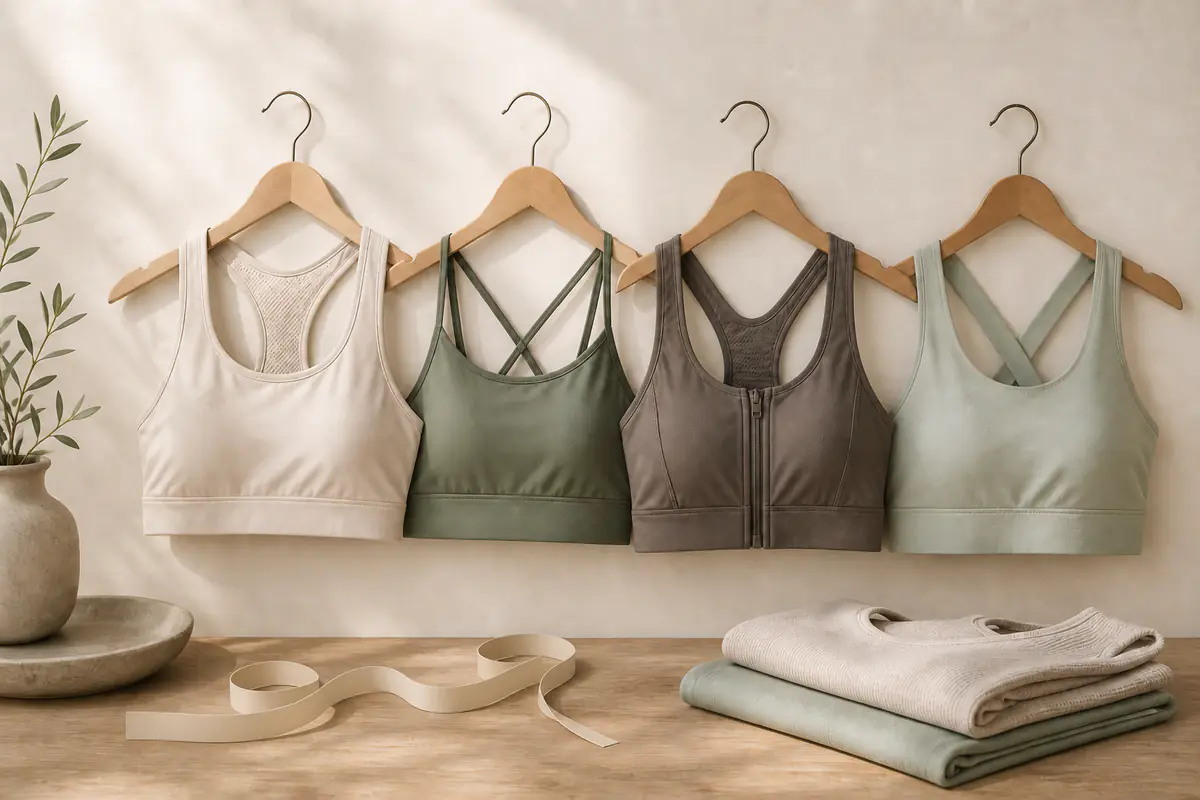
Straps should stabilise rather than carry the entire load. Inspect width, stretch, adjustment range, attachment points and whether sliders sit under a rucksack or on a high-friction area. Racerback, crossed and straight layouts change entry, shoulder pressure and compatibility with clothing.
Raise arms, reach forward and rotate the torso. A strap that stays put while standing may dig or slide during repeated movement. If adjustment is inaccessible once worn, confirm it can be set accurately before exercise without creating twisted hardware.
Choose entry and closure deliberately
Pullover bras remove hook hardware but can be difficult to take off when damp. Back hooks permit adjustment; front zips may improve access but add a closure that needs a secure guard and locking arrangement. Choose around mobility and the real changing routine.
Operate every closure several times indoors. Check that hooks stay flat, a zip cannot rub or open unintentionally and fabric is not trapped. Front opening does not by itself prove suitability after surgery or for a disability; individual clinical or occupational advice may be needed.
Map seams, edges and chafe points
Inspect armholes, neckline, underband, cup seams, labels and strap joins. Flat-looking seams can still rub when wet, while seamless construction can have bonded edges or dense transition zones. Product photos show position, not how the edge feels after an hour.
During a clean indoor trial, repeat arm swing, trunk rotation and bending for several minutes. Do not apply lubricant, cut labels or undertake a sweaty workout until the return decision is made. The online returns guide helps separate a careful fit check from use.
Treat fabric claims as specific evidence
Fibre content, knit density, lining and stretch direction affect feel and recovery. “Moisture-wicking”, “breathable” and “quick-drying” need test context to be meaningfully compared; they do not promise dryness in every temperature or intensity.
Read the sewn-in composition and care information on arrival. A sustainability or recycled-content claim should state its scope rather than implying that the whole garment has a lower impact. Use the greenwashing checklist before paying more for broad language.
Check opacity, coverage and outer-layer fit
Move under the lighting in which the bra may be worn alone, but remember that a home light check cannot predict every gym or outdoor condition. Check neckline, side and back coverage during bending and overhead movement, not only from the front.
Put on the intended top, jacket or pack while the garment remains clean. Hardware, thick straps and high necklines can conflict with other layers. Coverage that feels reassuring may also hold more heat, so match it to session duration and ventilation.
Plan washing before judging value
Read wash temperature, detergent restrictions, drying method and instructions for pads or fasteners. Heat and inappropriate treatment can damage elastic recovery, but hand-wash-only care may be unrealistic for frequent exercise. Value depends on a routine the owner will follow.
Fasten hooks and use a laundry bag if the label recommends it. Rotate garments only if the wearing frequency supports that purchase; do not assume buying several automatically extends total life in a predictable way. The care-label guide decodes the symbols.
Separate support failure from a size mismatch
Riding, spillage, bouncing, strap pressure and restricted breathing can have several causes. Record what happens, during which movement and at which adjustment before changing size or construction. Going smaller may increase compression without improving cup containment or band position.
Compare one variable at a time where returns allow: adjacent size, different cup structure or different closure. Do not diagnose pain or persistent skin symptoms through a shopping guide. Stop use and seek appropriate professional advice when discomfort continues.
Preserve hygiene and return rights
Sports bras may have hygiene-related return conditions, especially after labels, liners or packaging are removed. Read the exact policy before ordering and keep all supplied components while checking fit cleanly over the shortest permitted indoor trial.
For an online cancellation or a fault, identify the seller and preserve the listing, order, size chart and photographs of the issue. Do not wash, alter or exercise in a garment merely to create evidence; ask the retailer how it wants the item handled.
Compare real value without inventing lifespan
Build a delivered-cost comparison that includes any unavoidable return charge, then score activity fit, adjustment, comfort, care and likely wearing frequency. An expensive bra can be poor value when it is too awkward to put on, while a cheaper one is not economical if support is unsuitable.
Do not convert a warranty, price or fabric weight into an unsupported lifespan. Use actual wears and care records after purchase. If an existing bra still fits, recovers and supports the activity, replacement may not be necessary simply because a promotion presents a newer support tier.
Run a clean arrival protocol
First confirm model, size, colour and all components against the order. Inspect seams, elastic, closure and pads in good light, then try it on with clean skin and no fragrance, lotion or deodorant that could mark the fabric. Keep the dispatch packaging until the decision is recorded.
Take a full breath, raise and circle the arms, bend, rotate, perform a controlled squat and imitate the intended arm rhythm. Where safe and permitted, a few gentle hops can reveal movement, but this is not a workout or a medical test. Stop immediately for pain, numbness, breathing restriction or hardware pressure.
Recheck band level, cup containment, strap position and chafe points after the movement sequence. Photograph only the garment and any construction issue, not sensitive body images, when contacting a retailer. A written description tied to the order and size chart is usually safer and more useful than oversharing personal photographs.
Decide before washing or removing tags. Record keep, exchange or return, the precise reason and the deadline. If exchanging, change the smallest relevant variable and repeat the same clean protocol so the comparison remains meaningful rather than becoming a sequence of unrelated guesses.
Compression or encapsulation?
Simple close-to-body control suits the activity
The band remains level, breathing is unrestricted and the design contains movement without flattening pressure becoming uncomfortable.
Separate cup control and adjustment help
Cup shape, band and straps work together without gaps, spillage, rubbing or excessive hardware.
Balanced verdict
A sports bra is successful only when its support is usable for the real activity. Measure with the exact chart, inspect construction, rehearse movement cleanly and choose a care routine you can sustain.
The linked size, returns, quality and care guides support the evidence checks without replacing personal fit.
Official checks:
GOV.UK textile labelling guidance ↗
GOV.UK product safety advice ↗
GOV.UK returns and refunds ↗
CMA Green Claims Code ↗
Frequently asked questions
Does high support mean the same at every retailer?
No universal retail tier guarantees identical performance. Check the seller’s activity description, construction, sizing and return evidence.
Should a sports bra feel very tight?
It should be secure while allowing a full breath and movement. Pain, numbness, marked pressure or restricted breathing is a reason to stop.
Is compression better than encapsulation?
Neither is universally better — The useful design is the one that contains movement and fits the wearer and activity comfortably.
Can I test a sports bra by exercising in it?
Check the policy first. A clean indoor movement rehearsal may be allowed, while a sweaty workout can affect hygiene returns.
How often should a sports bra be replaced?
There is no honest universal number. Track fit, elastic recovery, damage, support and care rather than inventing a fixed lifespan.
Methodology and limitations
We assessed sports bras through activity demand, retailer support language, measurements, band and cup construction, straps, closures, seams, fabric claims, coverage, care, returns and delivered value. The sports-bra research record dates the official UK textile, safety, return and environmental-claim references to 1 September 2026. We did not wear-test or laboratory-test a named garment.
Limitations
Bodies, activities and comfort needs vary, and support tests are not presented consistently. This is buying guidance, not medical advice or a guarantee of injury prevention; stop for persistent pain and seek appropriate professional advice.