Fitted sheet slipping guide: mattress depth, elastic wear, washing and safe fixes
A fitted sheet slips when its size, pocket depth, elastic or installation does not match the complete mattress. Measure the bed, inspect the sheet and fix the cause safely.
In this guide
Measure the complete sleep surface before replacing the sheet
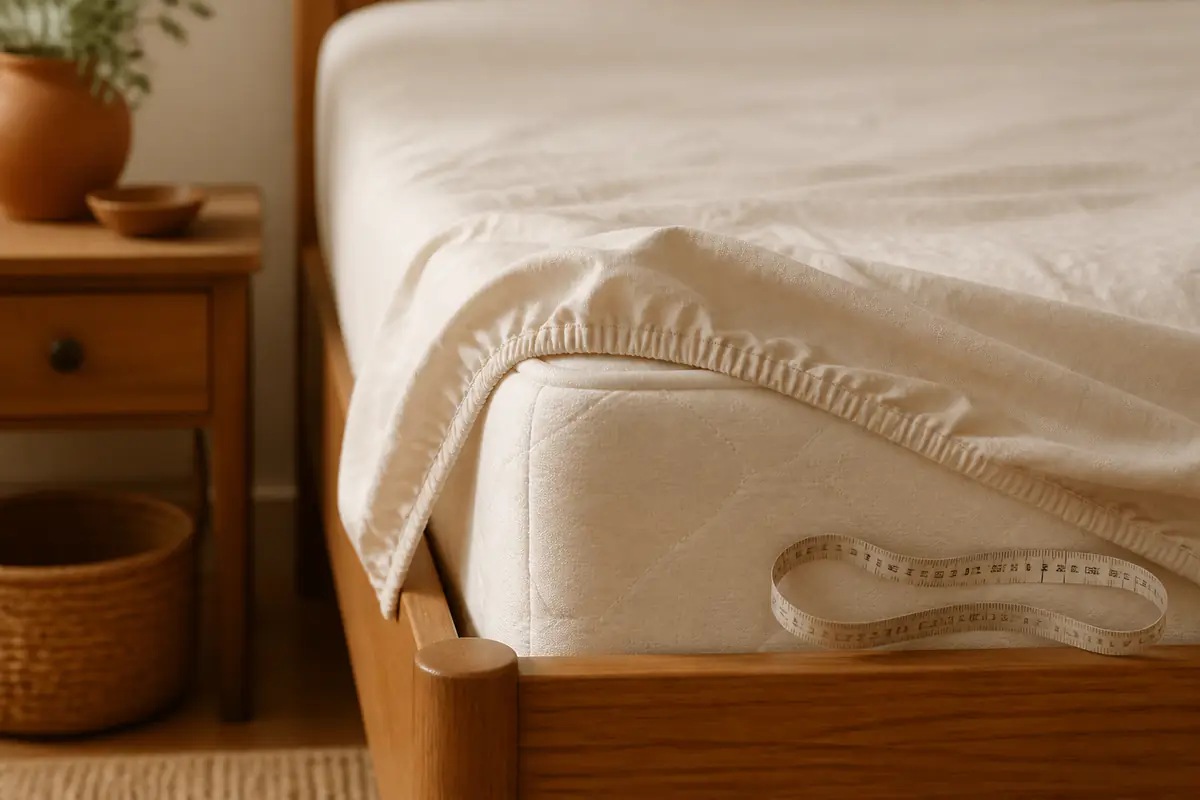
Record mattress length, width and total corner depth including any topper or protector that stays on the bed. Compare those numbers with the exact sheet specification. A deeper pocket is not always better: excess fabric and weak elastic can move as readily as an overstretched shallow sheet.
Use the bed-linen buying guide for fabric and set choice and the bed-linen ownership guide for general rotation. This page solves the narrower slipping problem with the dimensions and tolerances method.
| Symptom | Likely cause | Check | Best response |
|---|---|---|---|
| One corner lifts | Local depth, poor fitting order or weak corner elastic | Measure that corner and inspect seam | Refit; replace if elastic or seam fails |
| All corners strain | Pocket too shallow or sheet too small | Total mattress depth and platform size | Choose correct dimensions and depth |
| Fabric gathers and moves | Pocket too deep, sheet too large or smooth layers | Compare sheet and mattress specification | Use a better-sized sheet |
| Fit worsened after washing | Shrinkage, heat or elastic damage | Care label and pre/post dimensions | Adjust care; replace if recovery is lost |
Measure these before shopping
- Mattress length at the top surface.
- Mattress width at the widest point.
- Depth at all four corners.
- Topper depth if it remains fitted.
- Protector thickness and quilting.
- Rounded or square corner shape.
- Bed-frame obstruction around the edge.
- Current sheet dimensions and pocket claim.
Start with the bed as it is actually used
Remove the duvet and pillows but leave on every layer that normally sits beneath the fitted sheet: topper, padded protector and any fixed comfort layer. Measure the top length and width, then the vertical depth from the top surface to the lower edge the elastic must wrap beneath. Check all four corners because toppers can drift and mattresses can compress unevenly.
Do not rely solely on “double” or “king”. John Lewis’s current UK guide lists standard nominal dimensions and warns that non-UK mattresses can vary. IKEA’s current UK guide also distinguishes several UK sizes. A bed frame, imported mattress or older product may not match the label you remember.
Understand pocket depth
Pocket depth describes how much corner height the sheet is designed to accommodate, but retailers express it differently. John Lewis currently describes standard fitted sheets up to 30 cm and deep sheets up to 36 cm. Individual products can differ: current IKEA examples list maximum mattress thicknesses of 16, 26 or 36 cm depending on model.
Choose using the exact product specification and your complete fitted depth. Allow enough material to tuck under the mattress according to the design, but do not assume the deepest available pocket is safest. Excess fabric can gather and migrate, while an overstretched shallow pocket pulls upward with every movement.
Check length and width as well as depth
A sheet can have adequate pocket depth and still slip because its platform is too short or narrow. Stretching diagonally over the first two corners can hide the mismatch until the final corner is fitted. Measure the sheet after laundering and compare with the maker’s stated mattress fit rather than attempting to measure a fully elasticated edge under tension.
UK double and king differ in both width and length. An imported European size can be close enough to confuse but far enough to strain. If the sheet rotates, forms diagonal creases or repeatedly pulls from the same end, recheck orientation and platform dimensions before blaming the elastic.
Inspect the elastic and corner seams
Lay the clean, dry sheet flat and inspect the entire elastic channel. Look for a snapped section, hard or wavy elastic, detached stitching, torn corner seam or local loss of recovery. Compare opposite corners with light hand tension; do not stretch to the limit, which can worsen damage. Elastic all around the edge generally distributes grip more evenly than short corner pieces, but construction varies.
A failed seam can sometimes be repaired if fabric and elastic remain sound and the work does not create hard or sharp components. Perished elastic throughout usually makes replacement more sensible. The repair, rotate and retire guide offers a general evidence-led repair decision that also applies to household textiles.
Fit corners in a controlled order
Confirm the long and short sides, then fit the two upper corners before the lower corners, or follow the maker’s method. Pull the pocket fully over each corner and tuck the elastic below the mattress edge rather than leaving it halfway down the side. Smooth the centre outward without yanking one corner to compensate for another.
If the mattress is heavy, do not lift beyond your ability or trap fingers against the frame. Ask for help and use safe handling. A sheet that requires extreme force, mattress bending or repeated lifting is probably the wrong size or depth. Do not accept injury risk as proof of a “snug fit”.
Account for topper and protector movement
A topper can slide independently and pull the sheet with it. Centre the topper and ensure the protector fits both topper and mattress as intended. If a thick quilted protector adds depth or reduces friction, include it in measurements. Do not compress a deep topper under a shallow sheet simply to make the corners reach.
Observe which layer moves overnight. Mark alignment privately with removable non-damaging references before bed, then inspect in the morning. If the topper shifted while the sheet stayed attached to it, solve topper compatibility; if the sheet detached from a stable stack, focus on sheet size and elastic. Adjust only the sheet depth, protector or fastening method being investigated, so the cause of slipping stays identifiable.
Review washing and drying
Heat, agitation and repeated stretching can shrink fabric or weaken elastic. Follow the care label for the exact sheet, not a generic cotton rule. Current IKEA product pages illustrate why: fibre blends and models have different shrinkage and care information even when all are fitted sheets. Avoid exceeding wash or tumble limits and do not bleach unless explicitly permitted.
Measure fit after the sheet is fully dry and cooled. If a once-correct sheet became tight after a hot wash, compare dimensions and care history. If elastic feels slack after high heat, lowering future temperature cannot restore lost recovery. Use the bedding materials guide without treating thread count as an elastic-quality score.
Avoid improvised fasteners that create hazards
Do not secure a sheet with safety pins, loose cords, exposed clips, adhesive near skin or components that can damage the mattress, create entrapment or come loose in bed. Aftermarket under-mattress straps vary; only use a purpose-designed product whose instructions, compatibility and risks you have assessed, and keep it inaccessible to children.
A correctly sized replacement is usually the cleaner solution when the sheet or elastic has failed. Do not sew elastic blindly across the underside of an occupied sleep product. If a medical, profiling or adjustable bed is involved, use the bed and bedding manufacturer’s approved products so movement and cables remain unobstructed.
Choose a replacement from evidence
Shop with length, width, total depth and corner shape. Check whether the elastic runs around the full perimeter, the stated maximum mattress thickness and the expected shrinkage or care method. Read reviews only for the exact size and model. A statement that a sheet fits a deep mattress is weak evidence without the reviewer’s measured depth.
Keep packaging and the product specification until the sheet has been tried indoors and assessed for return condition. The online return deadline guide helps preserve the route. Wash only after fit is confirmed, because laundering normally changes change-of-mind eligibility and can change dimensions.
Test the fix over several nights
After correcting orientation, layers or size, make the bed consistently and note whether the same corner lifts. Check movement after ordinary sleep rather than pulling the sheet taut for a photograph. If a new sheet still slips, re-measure the mattress and inspect frame interference, topper drift and whether the listed size was supplied.
Retire a sheet with torn fabric, failed elastic or a repair that cannot remain smooth and secure. Sound fabric may be reused according to its condition, but remove elastic and any hardware responsibly. A stable fitted sheet should protect comfort and hygiene without nightly rebuilding or hidden sharp fixes.
Refit or replace?
Dimensions and elastic are still correct
The sheet matches the complete mattress, seams recover evenly and the problem comes from orientation or shifted layers.
Fit or material has failed
The pocket is wrong, platform dimensions mismatch, fabric shrank, elastic perished or safe fitting requires excessive force.
Balanced verdict
A slipping fitted sheet is a measurement and material problem, not a reason for hidden pins and improvised tension. Measure the full stack, compare exact dimensions and depth, inspect elastic, follow care instructions and replace a failed sheet honestly.
Use the linked bed-linen, dimensions, repair, bedding-material and return guides for the decisions they separately cover.
Official checks:
John Lewis official bed-linen size and depth guide ↗
IKEA UK official mattress size guide ↗
IKEA fitted-sheet dimensions and care example ↗
IKEA fitted-sheet depth and care example ↗
Frequently asked questions
Why does one fitted-sheet corner keep coming off?
That corner may have greater total depth, a damaged seam or elastic, incorrect fitting order, frame interference or a shifted topper. Measure and inspect it directly.
Should I always buy the deepest fitted sheet?
No — A pocket must accommodate the complete mattress stack, but excessive depth can leave loose fabric that moves. Use the exact product specification.
Does a mattress topper count in sheet depth?
Yes, if the fitted sheet wraps over it during normal use. Measure the mattress, topper and protector as one fitted stack.
Can tumble drying damage fitted-sheet elastic?
Excess heat can affect fibres and elastic. Follow the exact care label; limits differ by product and material.
Are safety pins a safe way to hold a sheet?
No — Avoid exposed or hidden sharp improvised fasteners. Correct the size, layers or elastic and use only compatible purpose-designed solutions.
Methodology and limitations
We reviewed current John Lewis and IKEA UK bed-linen, fitted-sheet and mattress size guidance on 2 September 2026. We separated platform size, total depth, layer movement, elastic condition, care, fitting and replacement. We did not test a particular sheet or mattress.
Limitations
Retailer dimensions, materials and care instructions vary. Adjustable, medical and specialist beds require manufacturer-approved bedding and may need professional handling advice. Measure the actual bed and follow the exact product label.