Choosing mascaras: brush shape, formula, removal and wear
Mascara performance is a system: brush geometry controls placement, the formula controls film and removal, and the eye area sets a strict tolerance for irritation and hygiene.
In this guide
Match the brush and removal method to the lashes and routine
A dramatic claim is less useful than a wand that can reach the intended lashes without repeated contact and a formula that removes without rubbing. Choose an unopened product from clear evidence, stop if irritation occurs and never share a wand or dilute a drying tube.
Build the whole routine with the facial-cleanser ownership guide, check labels through the cosmetics ingredients guide, and track opening hygiene with the PAO guide.
| Need | Brush evidence | Formula question | Main trade-off |
|---|---|---|---|
| Separation | Fine evenly spaced teeth | Controlled film and set time | Less bulk per pass |
| Volume | Dense bristles and product reservoir | Buildability without flaking | Clumps if overloaded |
| Short or lower lashes | Small narrow tip | Low transfer during placement | Slower full-lash application |
| Water resistance | Precise low-contact wand | Declared wear and removal route | Harder removal and more rubbing |
Mascara shortlist record
- Define separation, volume, length or curl priority.
- Record brush material, curve, taper and size.
- Check shade, finish and waterproof status.
- Read directions and eye-area warnings.
- Plan the matching remover.
- Check pack size and opening hygiene.
- Use one eye product at a time when troubleshooting.
- Replace when safety or performance changes.
Define the result without vague volume language
Decide whether the priority is separation, visible length, root definition, curl hold, colour or resistance to humidity and tears. “Dramatic” can mean several incompatible outcomes and does not state how many passes or how much clumping the result needs.
Write the ordinary wear period and removal time. A formula that lasts through an exceptional event may be unnecessarily difficult for daily use, while an easy-removing product may not suit exercise, watery eyes or long outdoor exposure.
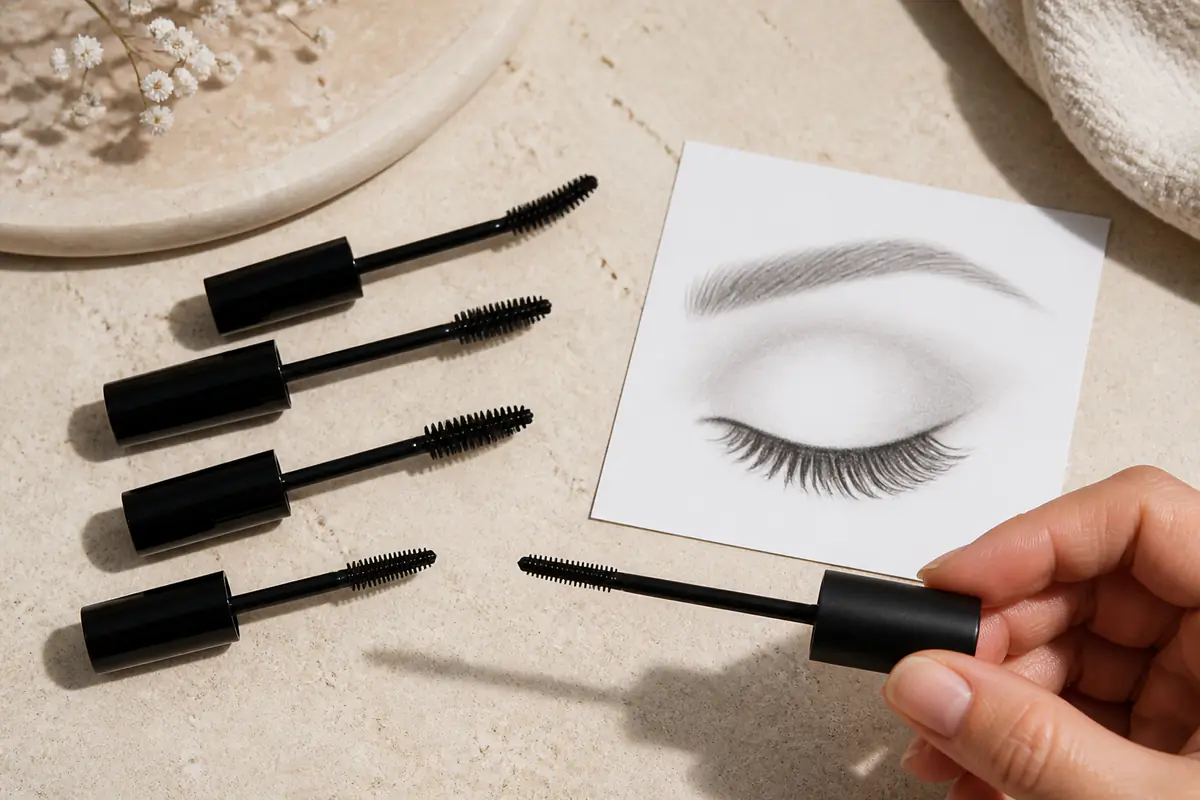
Brush diameter controls access
A large brush can cover upper lashes quickly but may touch the eyelid or miss short inner and lower lashes. A small brush improves access and control, though a full upper-lash application may take longer and require more strokes.
Compare brush diameter with eye shape, lash length and steadiness, not with the tube size. If contact is frequent, repeated clean-up can outweigh any theoretical volume advantage.
Bristle and tooth spacing controls deposit
Dense fibre bristles can carry and distribute more product; moulded teeth can provide defined spacing and scrape excess differently. Neither technology guarantees separation or volume because formula viscosity and wiper design also matter.
Look for close images of the clean brush rather than a heavily coated wand. A deep reservoir may build quickly but can overload fine lashes unless the tube wiper removes enough product.
Curve, taper and tip are application tools
A curved wand can support a lifting motion when its radius suits the lash line. A tapered tip may reach corners, while a ball or precision tip can place product on short groups but also increases the chance of skin contact.
Plan how the tool will be held with the dominant hand on both eyes. A complex brush is not better if it requires rotation near the eye that cannot be repeated safely and comfortably.
Formula family changes the removal bargain
Conventional washable formulas, water-resistant products, waterproof films and tubing-style products can respond differently to oil, warm water and friction. Use the maker’s current instructions rather than assuming the marketing category describes one universal chemistry.
Choose the remover before buying the mascara. If removal requires prolonged rubbing, the daily routine may be unsuitable even when daytime transfer is excellent. See our cleanser ownership method for a controlled routine.
Set time affects smudging and corrections
A slower-setting formula gives time to comb and layer but can transfer during blinking; a fast-setting film can resist transfer sooner but make clumps harder to correct. Application technique and climate change the experience.
Apply thin controlled passes within the stated directions. Do not pump the wand, add water or use saliva: these actions introduce air or contamination and do not safely restore a degraded formula.
Wear must be tested against the real day
Score upper-lid transfer, lower-eye smudging, flaking, curl change and comfort at relevant checkpoints rather than judging only the final mirror. Oily skin, tears, humidity, lenses and eye rubbing can change the result.
Do not deliberately expose eyes to extreme water or sleep in mascara to test claims. Stop at burning, persistent watering, swelling or blurred vision and seek appropriate advice where symptoms do not settle.
Sensitive eyes need fewer uncontrolled variables
Read ingredients, directions, warnings and period-after-opening information through the cosmetics-ingredients guide. Terms such as gentle or suitable for sensitive eyes do not guarantee individual tolerance.
Introduce one new eye product at a time and keep applicators clean. Patch testing on skin cannot prove eye-area safety, and another person’s experience cannot predict contact-lens or allergy response.
Colour and finish affect the buying brief
Black, brown and coloured formulas change contrast differently with hair, skin, eyewear and lighting. Glossy or very wet finishes may look stronger initially while a softer finish can suit everyday definition.
Check the exact shade name and variant because waterproof, washable and coloured versions can share similar packaging. On delivery, verify the sealed product before opening; an opened cosmetic may have restricted change-of-mind return options.
Calculate usable value, not nominal millilitres
A larger tube is not automatically better if the formula changes before it is used safely. Estimate applications within the declared post-opening period and the realistic frequency, then use beauty cost per use.
The best value may be the smaller or mid-priced option that works in one controlled pass and removes with the existing routine. Extra products bought to fix transfer or removal belong in the cost.
Treat hygiene as part of performance
Close the tube promptly, keep the neck clean without pushing debris inside and store away from heat. Never share mascara, transfer it to another container or use a shop tester directly on the eyes.
Replace immediately after a relevant eye infection or if advised by a professional. Discard a product whose smell, texture, colour, brush integrity or comfort changes even when the calendar suggests time remains.
Open only when the purchase is settled
Check shade, variant, seal, batch marking and external damage before breaking the closure. Cosmetics returns can be restricted after opening for hygiene reasons; our cosmetics-return guide explains the distinction between preference and a genuine fault.
Photograph leakage, a broken wand or an incorrect product before use. Do not insert a damaged brush near the eye simply to confirm that it fails.
Use a controlled first-wear record
Apply with the usual mirror and routine, record passes, set time and clean-up, then check comfort, transfer and flaking at normal intervals. Remove with the planned method and record time and friction.
A mascara passes when application, wear and removal all meet the brief. One spectacular photograph cannot outweigh daily irritation, difficult access or an impractical removal step. Browse Beauty for connected routines.
Which mascara profile suits the routine?
Access and easy removal matter most
Choose a smaller precise brush and a clearly described removable film when steadiness, short lashes or sensitive removal limits dominate.
Volume and long wear justify more technique
Choose a denser brush and resistant formula only when controlled layering and the required remover remain comfortable.
Balanced verdict
The best mascara is the one whose brush can be used safely and whose film survives the real day without making removal a daily penalty. Match tool, formula, eye tolerance and hygiene as one system rather than buying the loudest single claim.
Review the cleansing and storage guides before opening so the entire routine is ready.
Official checks:
NHS guidance on red eye ↗
GOV.UK cosmetic product guidance ↗
GOV.UK consumer protection rights ↗
Frequently asked questions
Are silicone mascara brushes better than fibre brushes?
Neither is universally better — Tooth spacing, shape, formula and tube wiper determine deposit and control together.
Is waterproof mascara suitable every day?
It can suit some routines, but wear benefit must be balanced against comfortable, manufacturer-consistent removal and individual tolerance.
Can I add water to dry mascara?
No — Dilution can change preservation and performance and introduce contamination. Replace a degraded product.
How can I reduce clumps?
Choose a brush and wiper that control deposit, use thin passes and work within the formula’s set time without repeatedly pumping the wand.
Can mascara be shared?
No — Sharing a wand or tube can transfer contamination between users.
Methodology and limitations
We assessed mascara by intended result, brush diameter and geometry, deposit, formula family, set time, wear, removal, eye-area safety, hygiene, packaging integrity and cost per realistic use. We did not apply products or claim clinical testing.
Limitations
Formula descriptions, ingredients, brushes and instructions vary and can change. Eye response is individual. Check the exact sealed product, maker directions and current professional guidance where symptoms or medical conditions are relevant.