Vitamin C serum ownership guide: oxidation, storage, hygiene and replacement
Record the exact formula and opening date, close it promptly, store it within the label conditions and compare colour, smell, texture and performance with the product’s documented baseline. Do not treat every yellow tint as identical or add ingredients to rescue a changed formula.
In this guide
Stability belongs to the exact formula and package
Vitamin C is a family of ingredients, not one universal bottle. Follow the product’s storage, period-after-opening and application directions. Stop if irritation is significant, packaging is compromised or the contents change beyond the maker’s stated normal range. A stronger percentage or more frequent use is not automatically better.
For selection before purchase, use our vitamin C serum buying guide and cosmetic ingredient-list guide. This page covers ownership after opening and does not diagnose or treat a skin condition.
| Observation | Check | Response |
|---|---|---|
| Small expected colour | Maker description and original photograph | Continue only if within stated normal condition |
| Progressive darkening | Age, air, heat, light and closure | Ask maker; replace if stability is uncertain |
| New smell or texture | Expiry, contamination and storage history | Stop and seek product-specific advice |
| Stinging or redness | Amount, frequency, other products and skin condition | Pause; obtain healthcare advice if significant or persistent |
| Leaking package | Cap, pump, dropper and seal | Do not decant casually; contact retailer or maker |
Record the baseline on opening
Photograph the outer box, batch, ingredients, period-after-opening symbol and bottle in neutral light. Write the opening date and retain storage directions. Note the initial colour, smell and texture without trying to create a laboratory standard at home.
Keep the receipt and product page. Formula names and percentages can remain familiar while packaging or ingredients change. Exact evidence matters for a recall, reaction or customer-service question.
Daily serum checklist
- Use clean, dry hands and the documented amount.
- Do not touch a dropper to skin or another product.
- Close the cap or pump promptly and fully.
- Return it to the permitted temperature and light conditions.
- Check for leakage, blocked dispensing or visible contamination.
- Keep sunscreen use aligned with current product and NHS guidance.
- Record irritation and every other active introduced nearby.
Understand oxidation without guessing
Different vitamin C derivatives and bases have different starting colours and stability. A serum may be clear, pale yellow, milky or intentionally tinted. Compare with the maker’s official description and your opening record. Do not use a social-media colour chart made for another formula.
Darkening, odour and texture change can indicate degradation, contamination or package failure, but home observation cannot quantify potency or safety. Contact the manufacturer with batch and photographs when uncertain. Do not shake, refrigerate or transfer unless instructed.
Storage is more than avoiding sunlight
Heat, repeated temperature change, air and moisture can matter. A bathroom shelf may be shaded yet warm and humid. A refrigerator may be outside the permitted range or expose the bottle to condensation. Choose a stable place that meets the label and remains inaccessible to children.
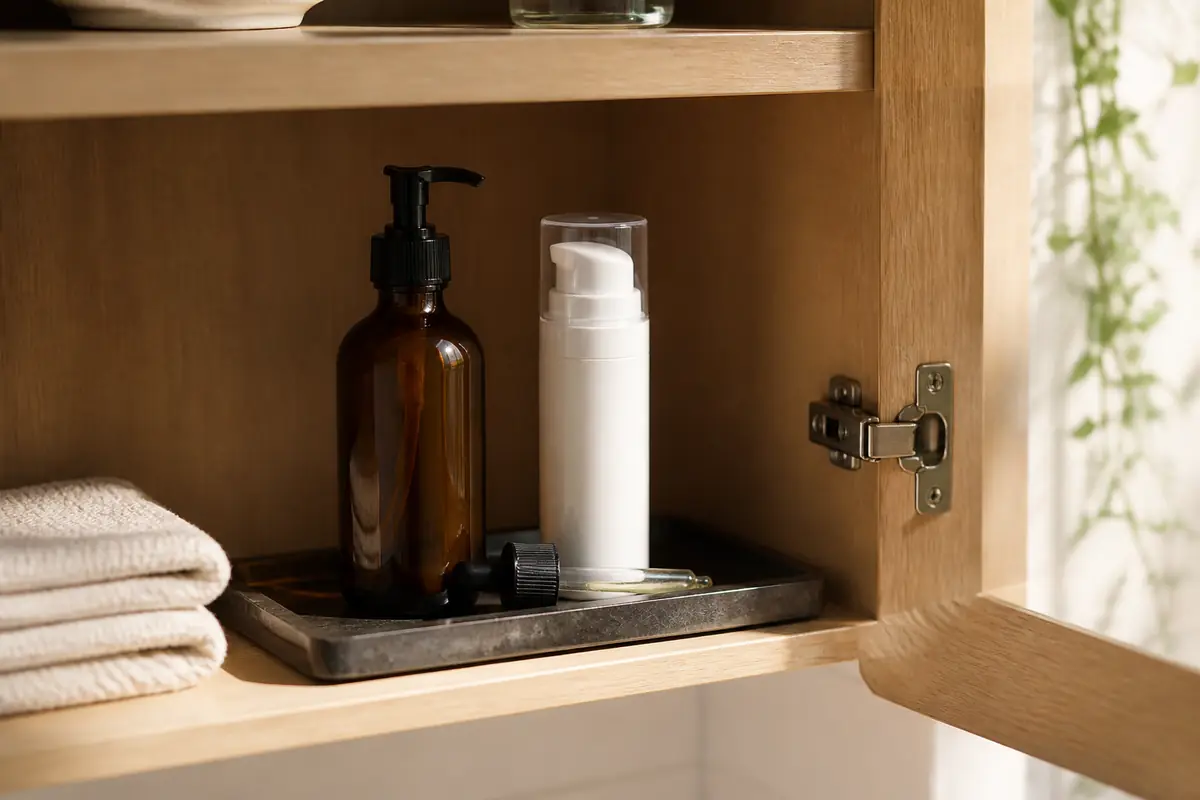
Keep the serum in its original package. Amber glass, opaque plastic, airless pumps and droppers manage exposure differently. A decorative clear bottle discards the system the formulator selected.
Introduce one variable at a time
Patch guidance and frequency belong to the label and any professional advice. Start only when the surrounding routine is stable enough to interpret a response. Adding an exfoliant, retinoid and new sunscreen in the same week creates uncertainty.
Our retinol ownership guide explains why escalation and irritation are not goals. If skin is broken, inflamed or undergoing treatment, obtain suitable healthcare advice before experimentation.
Layering order is formula-specific
Follow the maker’s application order, amount and drying instructions. “Thinnest to thickest” is not a complete compatibility rule. Acidity, solvent, film-formers and other active ingredients can alter comfort and application.
If products pill, simplify the routine and change one factor at a time. Do not compensate with extra serum. Pilling can reflect quantity or incompatible films and does not prove lack of absorption.
Pair the routine with sunscreen
A serum does not replace sun protection. Use a suitable sunscreen according to its directions and current health guidance, with shade and clothing where appropriate. Our facial sunscreen ownership guide covers storage and reapplication evidence.
Do not claim the serum allows lower SPF or less product. If several layers make sunscreen application unreliable, simplify the cosmetic steps rather than reducing protection.
Hygiene protects the formula
Do not share a dropper or apply it directly to skin. Wipe only the exterior by the permitted method. Water added to “thin” a serum can compromise preservation and concentration. A blocked pump should be handled through maker instructions, not opened with a pin.
If the container breaks, ask whether replacement is required. Decanting into an unsterile jar changes air, light and contamination exposure. Saving the remaining millilitres is not good value if its condition becomes unknown.
Use a six-week observation plan
Photograph the unopened container and batch information, then note the opening date, storage place, dose and morning routine. For the first fortnight, keep other active products stable and record stinging, persistent redness, dryness or rash rather than relying on memory. Skin appearance changes with lighting, sleep, hormones and weather, so compare photographs only in similar conditions and avoid promising a particular result date.
At weeks three and six, ask whether the serum remains comfortable, whether the container dispenses predictably and whether the colour or odour has changed materially from the opening baseline. A lack of dramatic visible change does not by itself prove oxidation, while a strong colour shift does not reveal the remaining concentration. The formula, package and manufacturer guidance matter more than a universal internet colour chart.
Separate compatibility from potency
More actives do not necessarily create a better routine. If vitamin C is combined with exfoliating acids, retinoids or benzoyl peroxide, irritation can come from total routine load, timing or vehicle rather than one headline ingredient. Introduce only one change at a time and use the product as directed. If the brand gives specific compatibility advice for the exact formula, prefer that over a generic layering rule.
Persistent burning, swelling, blistering or eye involvement is not an optimisation problem. Stop use and seek appropriate professional advice. Do not patch-test in a way that exposes broken skin, and remember that a small-area check cannot guarantee the face will tolerate repeated full use.
Know what evidence justifies replacement
Replace the serum when the manufacturer’s period-after-opening or expiry guidance is reached, the closure no longer protects the contents, contamination is suspected, the formula has separated unexpectedly, or a significant change is accompanied by reduced usability or irritation. Keep the container and order record when reporting a faulty pump, leakage or a formula that arrived visibly compromised.
Do not decant a reactive serum into a decorative transparent bottle. The original container is part of the stability system, and transfer adds air and contamination. Buying a smaller size that can be finished consistently may produce better value than a larger bottle discarded half-used.
Continue or replace?
Condition and tolerance remain documented
The product is within expiry and opening period, stored correctly, package intact and appearance within the maker’s normal description.
Stability or hygiene is uncertain
There is unexplained darkening, smell, texture change, contamination, leakage, package failure or a significant reaction.
Evaluate value by usable period
At the tolerated amount and frequency, estimate whether the bottle can be finished within its stated opening period. A large package is not better value when air exposure and slow use leave much of it questionable. Record skips rather than applying extra near expiry.
If a formula repeatedly changes before completion despite correct storage, ask about smaller packaging or a more stable derivative at the next purchase. Our beauty cost-per-use guide includes waste and tolerability rather than headline volume alone.
Returns, faults and reactions
Keep batch, box and photographs if the pump fails or contents arrive leaking or unusually changed. Contact the retailer promptly and describe condition without continuing to test it. Cosmetic change-of-mind exclusions and faulty-goods rights are different; see our cosmetics returns guide.
For a suspected adverse reaction, stop use and seek healthcare advice according to severity. Preserve the ingredients and batch for assessment. Do not reapply solely to prove causation.
Plan travel and repurchase without destabilising the bottle
For travel, keep the original closure secured and follow the maker’s storage range. Do not leave the bottle in a hot car, on a sunny windowsill or in a damp open wash bag. If the package is glass, protect it from impact without wrapping a leaking or damaged closure and hoping it survives.
Start repurchase review while enough product remains to observe condition, not after an unexplained change forces an urgent replacement. Compare usable volume, packaging, tolerated frequency and the time taken to finish the bottle. A formula that stays comfortable and predictable in a smaller opaque pump can offer better ownership value than a discounted large dropper bottle. Avoid stockpiling multiple unopened units unless their expiry and storage requirements make that realistic.
Balanced verdict
A good vitamin C routine is stable, documented and tolerable, not maximally strong. Original packaging, prompt closure and consistent storage provide more control than online oxidation folklore.
Replace when package, formula condition or skin response makes evidence uncertain. Browse Beauty for related label and routine guides.
Official checks:
GOV.UK cosmetic product guidance ↗NHS sunscreen and sun safety ↗UK safety alerts and recalls ↗
Frequently asked questions
Does yellow serum always mean oxidation?
No — Some formulas start tinted. Compare with the exact maker description and opening record.
After opening a vitamin C serum, when is fridge storage appropriate?
Only when the label or manufacturer permits it. Unapproved refrigeration can add condensation and temperature cycling.
Can I use it with retinol?
Compatibility and timing depend on the formulas and skin. Follow labels and professional advice rather than a universal rule.
Can I decant a leaking bottle?
Do not assume so — Contact the maker because a new container changes stability and hygiene.
When should I replace it?
At expiry or opening limit, or sooner for unexplained change, contamination, package failure or significant intolerance.
Methodology and limitations
We assessed records, formula variation, storage, oxidation evidence, layering, sunscreen, hygiene, value and replacement using UK cosmetic and NHS sources. No chemical stability assay was performed.
Limitations
Ingredients, concentrations, preservatives and packaging vary. Exact label, manufacturer and healthcare advice take priority.