UK delivery rights when a parcel is late, lost or left in the wrong place
When a business arranges delivery, the retailer normally remains responsible until the goods reach you or an agreed recipient or safe place. The right remedy depends on the promised date, whether timing was essential and whether you authorised the location where the parcel was left.
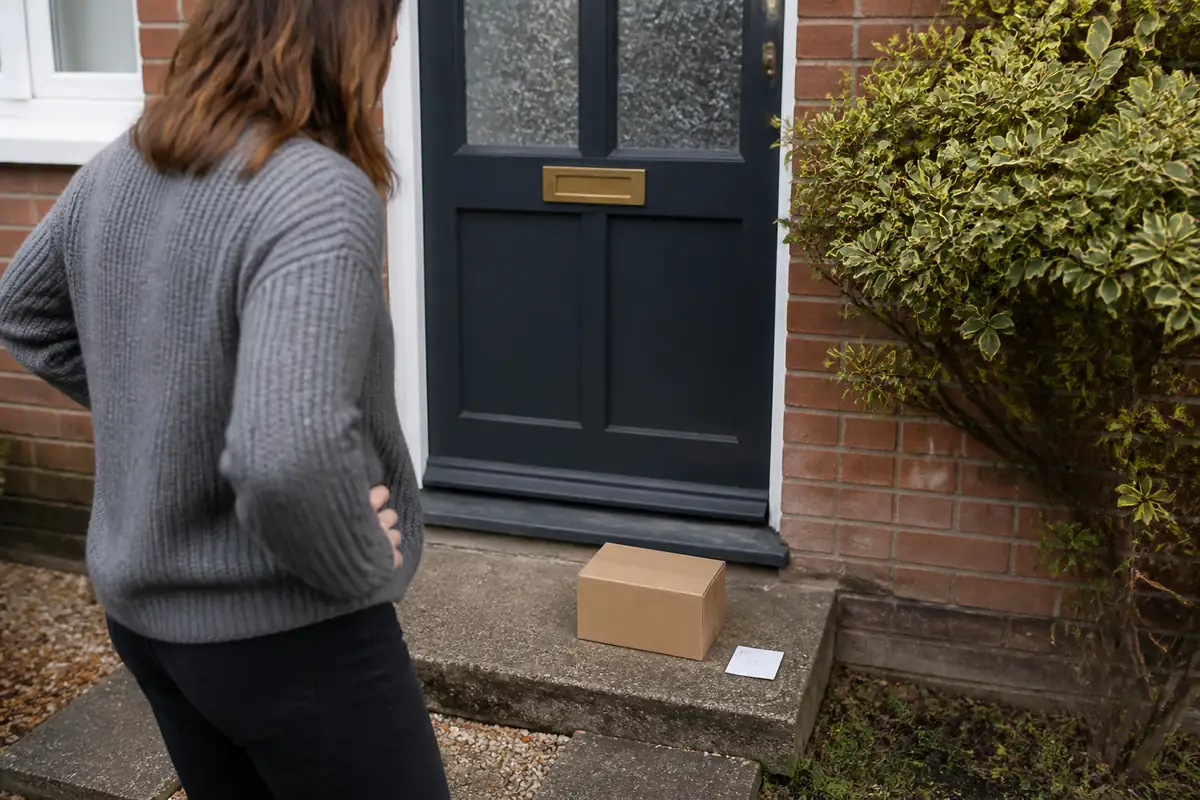
In this guide
Start with the retailer, document the promise and ask for the remedy that fits the facts
Do not let a retailer send you in circles between customer service and its courier. Save the order, delivery promise, tracking and safe-place instructions, then contact the seller in writing. If no delivery date was agreed, goods should normally arrive without undue delay and within 30 days. A missed essential date, or a failed reasonable second deadline, can support cancellation and refund.
This article explains the general position for UK consumer purchases from businesses. It is not individual legal advice. Rules and practical routes can differ for private sellers, independently booked couriers, overseas transactions and authorised safe places. Keep the exact contract and seek tailored advice for a disputed high-value claim.
Your position at a glance
| Situation | Who to contact first | Usual next step |
|---|---|---|
| Retailer’s courier is late | The retailer | Ask for a firm delivery update or set a reasonable second deadline |
| Essential agreed date was missed | The retailer | State why timing was essential and ask to end the contract if appropriate |
| Tracking says delivered, but not received | The retailer | Dispute delivery and request evidence, redelivery or refund |
| Parcel left in a place you did not authorise | The retailer | Explain that the agreed delivery was not completed |
| Parcel lost from a place you expressly authorised | Check the agreement and seek advice | Responsibility may have passed on delivery to that place |
| You independently hired the courier | The courier you contracted | Check that separate service contract and evidence |
The retailer normally carries the delivery responsibility
If you bought from a business and it selected or contracted the courier, the seller is normally responsible for getting the goods to you. Citizens Advice states that the seller should chase its courier; that is not a task the consumer must accept instead of a remedy. You can provide tracking details and cooperate with a sensible investigation, but your contract remains with the trader.
This distinction matters when a courier’s automated page offers only a chatbot or says the sender must open a claim. Contacting the courier may help locate a parcel, yet it does not replace a clear written request to the retailer. Identify the actual seller first when buying through a platform. Our marketplace seller or retailer guide shows where to find the contracting trader and why the platform name alone may not answer the question.
Evidence to save before pages change
- Order confirmation, seller identity, item description and total paid.
- The promised delivery date or estimated window shown at checkout.
- The full address and any safe-place or neighbour instruction you actually gave.
- Tracking history, delivery photograph and time stamp.
- Doorbell or building-entry evidence, if lawfully available.
- Messages with the retailer and courier, including reference numbers.
- Proof of any second deadline, cancellation and refund request.
The 30-day rule and an agreed date are different checks
Under section 28 of the Consumer Rights Act 2015, where no delivery period is agreed, the trader must deliver without undue delay and generally no later than 30 days after the contract is made. GOV.UK’s distance-selling guidance also tells businesses to deliver within 30 days unless another arrangement was agreed.
That does not mean every retailer automatically gets 30 days after promising Tuesday. An agreed delivery date forms part of the contract. If the date passes and time was not essential, the usual route is to require delivery within an additional period appropriate to the circumstances. If that reasonable second deadline also passes, the consumer can treat the contract as ended.
A date can be essential because you told the retailer before contracting, or because the circumstances make that obvious. A wedding cake for the wedding day is the standard example. “I hoped it would arrive before my trip” is weaker if the retailer was never told and did not promise that date. Preserve the checkout wording: an “estimated” window may not carry the same precision as a guaranteed service.
When can you cancel for late delivery?
The Consumer Rights Act allows the consumer to treat the contract as at an end immediately in specified circumstances, including where the trader refused delivery, delivery by the agreed time was essential, or the consumer made clear before the contract that delivery by that time was essential. Otherwise, give the trader an appropriate second period and cancel if it fails again.
| Question | If yes | If no |
|---|---|---|
| Did the retailer refuse to deliver? | Immediate cancellation may be available | Check the date and next steps |
| Was the agreed date objectively essential? | Explain the circumstances and request cancellation | Set a reasonable second deadline |
| Did you tell the retailer timing was essential before purchase? | Refer to the saved message or checkout note | Do not rewrite the history after the event |
| Has the reasonable second deadline passed? | Ask to end the contract and refund | Allow the stated period to run |
If only some goods are late, the remedy can be more complicated. Consider whether the order is severable and whether the delivered part has value on its own. Do not return or dispose of goods without recording the retailer’s instructions. Our broader UK returns and refunds guide separates non-delivery from change-of-mind and faulty-goods routes.
Tracking says delivered, but the parcel is missing
A carrier scan is evidence, not an infallible conclusion. Check the full address, household members, reception area and only the neighbour or safe place you agreed. Ask the retailer for the delivery photograph, coordinates or other evidence it relies on, while avoiding public sharing of images containing addresses or faces.
If the parcel was left with a neighbour or in a location you did not authorise, Citizens Advice says the seller remains responsible and you can ask for redelivery or refund. State the exact agreed delivery point and that the goods were not delivered there. Avoid saying merely “stolen”, which may concede a completed delivery before the facts are established.
A concise written sequence
- State the order number, item and agreed delivery location.
- Say that you have not received the goods and dispute the delivery record.
- List the checks already made without speculating about theft.
- Ask for the evidence and your preferred remedy: redelivery or refund.
- Give a reasonable response deadline and keep the conversation in writing.
Safe places and neighbours: authorisation changes the analysis
If you expressly asked for a parcel to be left in a particular porch, shed or with a named neighbour, responsibility can pass when delivery is properly made there. Read the instruction saved in your account and the exact carrier evidence. A vague default buried in account settings may produce a factual dispute about consent, so capture the setting before changing it.
If the retailer or carrier chose a place you did not agree, tell the retailer that delivery was not made to you or the agreed alternative. Do not accept a generic claim that any photograph proves compliance. The important questions are which location was agreed, whether the parcel was actually placed there and whether the item shown is your order.
Damaged, partial or substituted deliveries
A parcel can arrive without completing the contract correctly. Photograph external damage before opening, then record the contents, seals, serial or model details and missing pieces. An empty package, wrong item or incomplete multi-box order is not merely a courier-delay problem. Tell the retailer precisely what arrived and avoid sending original evidence away without copies.
For a large marketplace order, confirm whether different sellers or dispatches were involved. A single platform basket may produce separate contracts and tracking numbers. The review-quality guide can help assess a seller’s history before purchase, but reviews do not replace contractual evidence after a loss.
Escalation and payment protection
Give the retailer a fair opportunity to resolve the complaint, using its formal complaints route if needed. Record what remedy you requested and why. A payment dispute is an escalation route, not a substitute for clear facts. Chargeback is a card-scheme process with time limits and evidence requirements; Section 75 has different statutory conditions for qualifying credit-card purchases. Do not claim both as interchangeable guarantees.
If the order used regulated third-party buy now, pay later, consult the provider’s dispute route and the agreement. Our buy now, pay later guide explains why the provider, agreement date and cash price matter. Keep any repayment schedule under review while the dispute is open rather than assuming payments pause automatically.
For scams, do not pay a surprise “redelivery fee” through a link in a message. Citizens Advice warns that parcel texts or emails demanding payment or rescheduling through a link are usually scams. Open the retailer or carrier site independently and compare the tracking number.
Ask for redelivery or ask for a refund?
Choose redelivery if…
- You still need the item and a realistic replacement date works.
- Stock exists and the retailer confirms the new arrangement in writing.
- The first date was not essential or you willingly accept a second attempt.
- A safer agreed collection or delivery point is available.
Choose cancellation if…
- An essential agreed date was missed and the item is no longer useful.
- The retailer refused delivery or failed an appropriate second deadline.
- Replacement stock or timing is too uncertain.
- You can return any later-arriving goods according to written instructions.
Our verdict
The strongest late-parcel complaint is factual, proportionate and directed to the seller. Identify the agreed date and place, preserve the evidence, distinguish an essential deadline from an estimate and request redelivery or refund on the correct basis. Do not let a retailer outsource its contractual answer to a carrier it selected.
Before another purchase, compare the delivered total and the delivery promise rather than a headline product price. Our drip-pricing guide shows how compulsory delivery costs affect the real total, while the discount guide keeps urgency and reference prices in perspective. Browse all buying guides for related evidence and complaint frameworks.
Check current official and independent UK information:
Consumer Rights Act 2015, section 28 ↗GOV.UK distance-selling requirements ↗Citizens Advice: item not delivered ↗
If the product has not been released yet, check the separate timing and cancellation issues in our Pre-ordering products: deposits, release dates and cancellation rights.
Frequently asked questions
Is the retailer or courier responsible for a missing parcel?
When the retailer arranged the courier, start with the retailer. It is normally responsible for delivery to you or an agreed alternative location and should pursue its carrier.
Must an online order arrive within 30 days?
If no other period was agreed, the trader must generally deliver without undue delay and within 30 days. A specific agreed date can create an earlier contractual obligation.
Can I cancel immediately when delivery is late?
Sometimes: for example, when the retailer refused delivery or an agreed deadline was essential. Otherwise, an appropriate second delivery period is normally required before cancellation.
What if tracking says delivered but I received nothing?
Dispute delivery with the retailer in writing, confirm the agreed address or safe place, request its evidence and ask for redelivery or refund according to the facts.
Who is responsible if I authorised a safe place?
If the parcel was properly delivered to a place you expressly authorised, responsibility may have passed. Check the exact instruction and seek tailored advice if the evidence is disputed.
Should I use chargeback for a lost parcel?
First document the non-delivery and ask the retailer to resolve it. Chargeback may be an escalation option depending on the card scheme, timing and evidence, but it is not an automatic court judgment.
How we researched UK delivery rights
We reviewed section 28 of the Consumer Rights Act 2015, current GOV.UK distance-selling guidance and Citizens Advice non-delivery guidance on 18 August 2026. We converted the legal sequence into a practical evidence and remedy framework without inventing a retailer policy or individual outcome.
Limitations
The delivery-rights framework explains general consumer principles; it does not determine liability or provide legal advice for an individual missing-parcel dispute. Jurisdiction, trader status, contract wording, payment method, independently arranged carriage, authorised safe places and the value of a partial delivery can change the analysis. Official pages and legislation should be checked again before purchase and before acting on a disputed high-value case.