Letterbox gifts: dimensions, freshness, delivery and presentation
“Letterbox” is a delivery claim, not a universal package size or promise that a parcel fits every door. Check the carrier format, packed thickness and weight, recipient’s actual opening, contents, temperature sensitivity, delivery evidence and what happens if the item cannot be posted.
In this guide
Buy the delivered condition, not the slim-box photograph
Verify final packed dimensions, carrier service and a safe recipient route before choosing contents. Then match shelf life, allergens, fragility and presentation to the delivery window. A slightly larger tracked parcel can be a better gift than a thin box forced through an uncertain opening.
This guide covers ordinary UK gifts sent to a home address. It does not guarantee access to communal buildings, prevent theft after delivery or replace carrier restrictions for food, plants, liquids, alcohol, batteries or valuables.
Separate carrier format from household letterbox
Royal Mail currently lists Large Letter limits of 35.3 × 25 × 2.5 cm and 750 g for UK consumer services. Other carriers and business products use different formats. Even a compliant mailing item may not pass through a narrow, angled, weather-sealed or communal opening.
Ask the seller for packed, not product, dimensions and total weight. “Fits most letterboxes” needs a stated basis. If the recipient has a parcel box or safeplace, confirm the carrier can use it under the chosen service.
| Gift type | Strong evidence | Main delivery risk |
|---|---|---|
| Cards and flat keepsakes | Packed rigidity and corner protection | Bending, moisture and surface damage |
| Confectionery | Allergens, shelf life and temperature limits | Heat, crushing and delayed discovery |
| Flowers or plants | Dispatch day, hydration and recovery instructions | Temperature, darkness and perishability |
| Miniature toiletries | Seal, volume and leak containment | Leakage and ingredient suitability |
| Personalised item | Approved proof and production deadline | Irreversible error and limited cancellation |
Pre-order delivery note
- Recipient name, exact address and postcode.
- House, flat, concierge or communal-entry constraints.
- Packed dimensions, weight and carrier format.
- Dispatch date, delivery aim and tracking level.
- Contents, allergens, shelf life and storage.
- Gift message proof and whether price paperwork is omitted.
- Late, damaged, missing and refused-delivery remedy.
Measure the route, not only the opening
A parcel must reach the door. Communal entry, locked gates, reception hours, rural addressing and name mismatches can block delivery. Ask the recipient discreetly or use a work or collection address only with consent and compatible carrier terms.
Do not publish access codes in seller notes unless the approved process is secure. A safeplace can expose food, flowers or cosmetics to weather and should be appropriate for the contents.
Choose protection before decoration
The outer pack needs enough rigidity, moisture resistance and closure for sorting and delivery. Interior dividers should stop movement without crushing the item. Decorative tissue cannot replace structural protection.
Check whether presentation survives posting: loose confetti can scatter, glass can break and ribbon can snag. A plain recyclable outer mailer with a neat internal reveal is often stronger than a decorative box designed for hand delivery.
Match freshness to dispatch uncertainty
For food, flowers and other perishable goods, distinguish dispatch date from delivery date and delivery aim from guarantee. Count shelf life from manufacture or packing where stated, not from when the recipient opens it. Weekend and bank-holiday timing can matter.
Ask for ingredients, allergens, storage and use-by or best-before information before ordering. Do not infer suitability from a photograph. A substitute should not be accepted silently when allergens or dietary requirements matter.
Control temperature-sensitive contents
Chocolate can bloom or deform in heat; flowers can suffer cold or prolonged darkness; cosmetics may have storage limits. Sellers should define any seasonal dispatch pause, insulation and claim process. A narrow box offers little thermal protection by itself.
Choose a delivery day when the recipient can retrieve the item promptly. If that cannot be arranged, use a less sensitive gift or a collection route rather than hoping the letterbox solves exposure.
Review personalisation at actual size
Copy the name and message from a trusted source, preserve intended capitals and punctuation, and check character limits. Approve a proof where available, including line breaks and placement. The personalised-gift checklist covers production and cancellation risk.
Do not use a private message or sensitive life event on an outer pack. A blank or discreet exterior is safer for communal hallways and shared homes.
Price the whole delivery
Compare product, personalisation, gift wrap, message, delivery, tracking and time-slot fees. A low item price can become poor value after mandatory delivery. Conversely, a tracked inclusive total may be stronger even if the base product costs more.
For a group gift, the gift-card and store-credit guide helps decide whether a flexible digital option is better than a time-sensitive physical parcel.
Check seller identity and dispatch evidence
Verify the site, legal contact information and payment route using the genuine-shop checklist. Social posts and attractive unboxing videos are not evidence that the seller can meet a dated delivery promise.
Save product description, contents, dimensions, message, delivery service and confirmation with the purchase-documentation guide. Exclude unnecessary recipient data from any public complaint.
Plan for failed letterbox delivery
Ask whether the carrier leaves the parcel, attempts redelivery, uses a safeplace or takes it to a collection point. “No signature” does not necessarily mean “posted through the door”. Tracking may show delivery without identifying condition.
If the gift is damaged, late or missing, the buyer normally needs to contact the trader. The recipient should photograph the unopened outer package and damage without discarding contents or labels until instructions arrive.
Choose for the recipient, not the format
Letterbox delivery is useful when surprise and absence matter, but it limits volume and can encourage filler. Start with allergies, interests, storage, household context and whether the recipient wants physical items. The practical-gift method avoids duplicates and maintenance burdens.
A handwritten card alone may be more welcome than samples chosen to fill a box. Presentation quality is not measured by item count.
Audit returns and perishable exceptions
Change-of-mind cancellation can differ for personalised and rapidly perishable goods, while faulty or misdescribed items are a separate issue. Read the seller’s process before ordering, especially for photos, proofs and date-specific delivery.
Use the returns-policy checklist to identify who reports a problem, what evidence is needed and whether replacement would still be useful after the occasion.
Build the gift backwards from the arrival moment
Picture who will retrieve the parcel, when they are likely to see it and what must happen next. A recipient in a house may collect it within minutes; a resident in a managed block may need a concierge, access code or collection journey. Someone travelling, working shifts or managing allergies may benefit more from a durable, clearly described item than fresh food or flowers that demand immediate attention.
Choose the delivery day before finalising contents. Avoid a dispatch pattern that could leave a perishable gift in a network or communal area over a weekend. If the occasion is immovable, build in recovery time rather than asking the seller to hit the last possible service. Record an alternative contact method that does not reveal the surprise but allows the carrier to resolve access.
Final checkout test
- Confirm the packed format, weight and chosen carrier service.
- Check the complete recipient name, building detail and postcode.
- Review ingredients, allergens, shelf life and storage instructions.
- Read the personalisation exactly as it will be produced.
- Save the promised dispatch and delivery window.
- Know the seller’s remedy if tracking stalls or contents arrive damaged.
Make presentation survive the journey
Presentation should still make sense after mechanical sorting and passage through the opening. Tissue, loose confetti and delicate arrangements can shift, while tightly packed heavy pieces can mark soft contents. Look for internal restraint, separation of edible and non-food items, and a clear opening sequence. A gift note should be protected from moisture and should not expose private information on the outer pack.
Ask for a truthful description of the delivered layout rather than assuming the listing photograph shows the post-transit state. Where the emotional impact depends on a particular arrangement, a hand-delivered or collected gift may be the more reliable format.
Choose letterbox delivery when
- Packed dimensions and route are genuinely compatible.
- Contents tolerate likely transit and retrieval time.
- Presentation remains intact after sorting.
- Failure and damage remedies are clear.
Choose another route when
- The opening or communal access is uncertain.
- Temperature, fragility or value needs handover.
- The recipient must inspect or refrigerate promptly.
- A collection point provides better control.
Balanced verdict
A letterbox gift succeeds when delivery geometry, contents and recipient context align. Slim packaging is only one part of that system.
Verify packed dimensions and handling first, then judge freshness, presentation and total cost. A modest durable item that arrives intact is more thoughtful than a larger themed assortment exposed to avoidable risk.
Check current official information:
Royal Mail UK formats and servicesRoyal Mail measuring guidanceGOV.UK returns and refunds
Frequently asked questions
What is the Royal Mail Large Letter limit?
Check the live Royal Mail page; at review it listed 35.3 × 25 × 2.5 cm and 750 g for the consumer format.
Does Large Letter mean it fits every home letterbox?
No. Door openings and access routes vary.
Can fresh flowers be sent through a letterbox?
Some sellers design for it, but verify dispatch, temperature, hydration, retrieval and remedy.
Is tracked delivery guaranteed delivery?
No. Tracking and a guaranteed service are different; read the chosen terms.
Can a personalised letterbox gift be cancelled?
Change-of-mind rights can be limited for clearly personalised goods; faults and misdescription are separate.
Should prices be hidden from the recipient?
Ask whether invoices are omitted, but keep the buyer’s digital proof securely.
How we researched this guide
Recommended Today reviewed current Royal Mail formats and measuring guidance, UK returns information and the practical requirements of perishable, fragile and personalised gifts.
Limitations
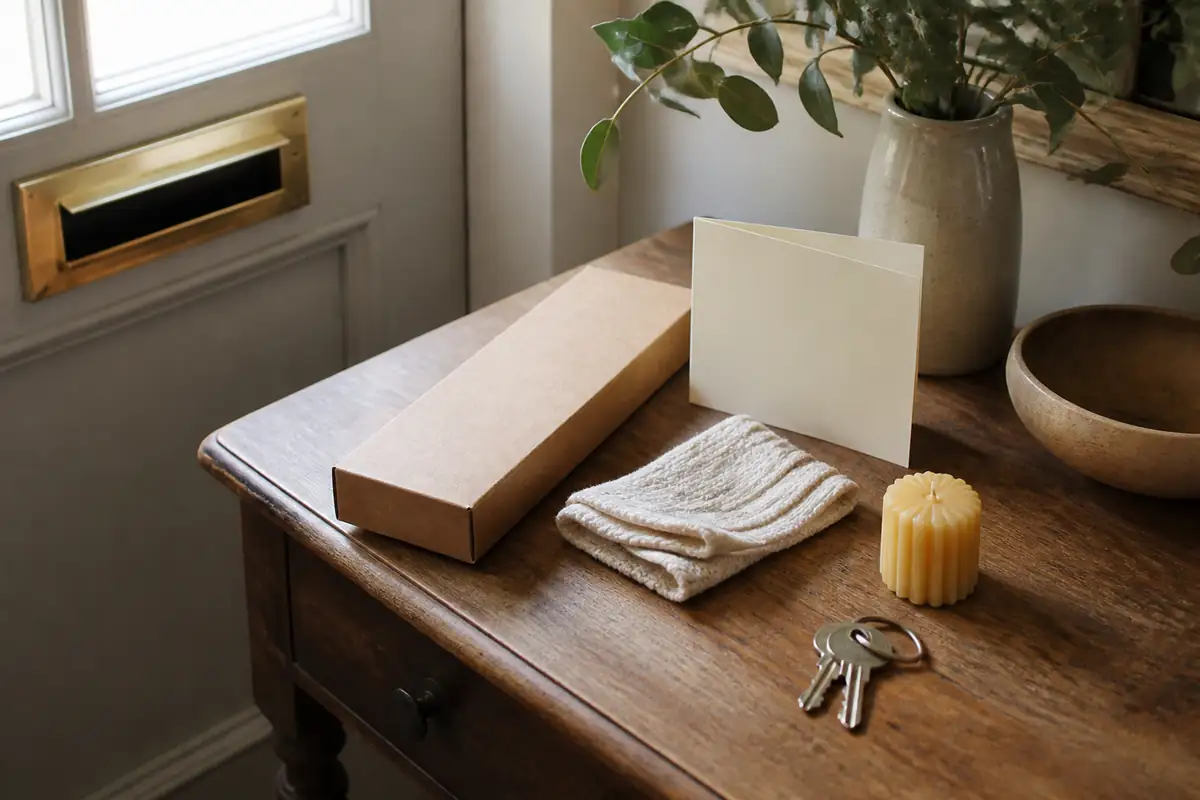
We did not post a box or inspect a recipient’s door. Carrier limits, prices, sellers and conditions change. Recheck the live service and address before purchase. The image is an editorial illustration, not a photograph from a product test.