Hot water bottle ownership guide: inspection, filling, covers and safe retirement
A hot water bottle holds very hot liquid close to the body. Check its age and condition before every fill, follow its instructions and retire it at the first warning sign.
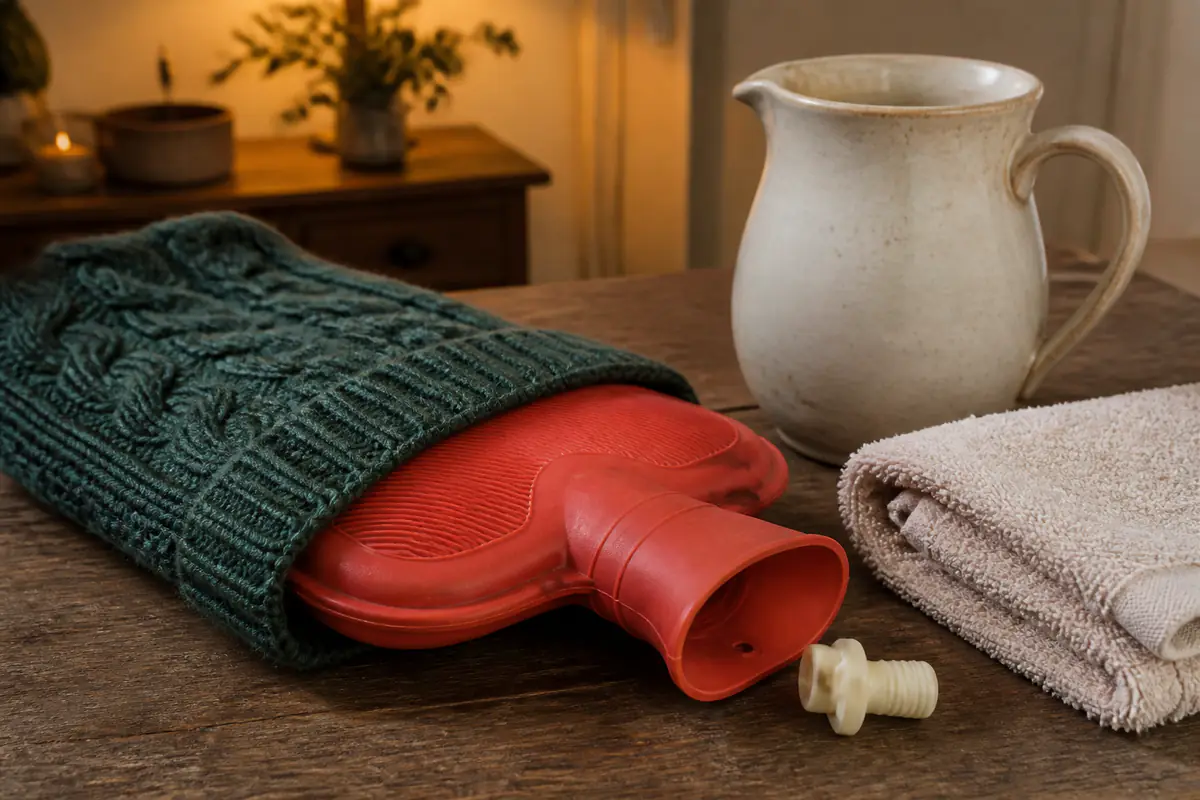
In this guide
Inspect cold; fill only a sound bottle
Check the body, neck, seams and stopper in good light before adding water, and follow the instructions printed on the exact product. Never use boiling water, do not overfill, expel excess air carefully, close the stopper straight and test for leakage away from the body.
This is a non-electric warming-product guide, distinct from our portable heater buying guide. Before purchase use the genuine-shop guide and product shortlist method; after delivery keep the instructions with the purchase evidence record.
| Check | Accept | Stop and retire | Reason |
|---|---|---|---|
| Body and seams | Flexible, even and undamaged | Crack, split, brittleness, fading or bulge | Heat and pressure exploit weak material |
| Neck and stopper | Straight thread, secure fit, no leak | Distortion, damaged thread or substitute stopper | Seal failure can release hot water |
| Age and history | Known purchase/use history within maker advice | Unknown old bottle or repeated misuse | Damage can be internal or hidden by a cover |
| Cold leak test | Dry after manufacturer-approved check | Any dampness or loss | A leak is not repairable for safe hot use |
Safe fill sequence
- Read the exact manufacturer instructions.
- Remove the cover and inspect cold.
- Use hot water that is not boiling.
- Fill slowly over a sink or safe surface.
- Do not exceed the instructed fill; CAPT says no more than two thirds.
- Expel excess air carefully.
- Screw the correct stopper straight and tight.
- Check for leakage before fitting the cover.
Why routine inspection matters
Hot water bottles age through heat, flexing, storage and pressure. A knitted cover can hide fading, a split starting at a seam or damage around the neck. The Child Accident Prevention Trust warns that old bottles can break and cause serious burns, and identifies boiling water, storage near heat, sharp damage and storage while full as factors that degrade them.
Inspect before every use while the bottle is cold and empty. Work in good light and remove the cover. Flex the material only as the maker permits; do not aggressively stretch it to “test strength”. A suspicious area is a reason to stop, not to run a hotter trial.
Read the date mark and purchase history
Many rubber hot water bottles have a moulded flower or daisy date code on the neck. The centre indicates the manufacturing year and segments indicate month or week patterns. Use the maker’s explanation for the exact design, because an online diagram can be misread. Record the purchase date and first-use date as well as the manufacturing mark.
Age alone is not a pass or fail: misuse can damage a newer bottle, while a visually tidy old bottle can have hidden degradation. UK burns specialists commonly recommend replacement around two years from first use, but follow the product’s own guarantee and retirement instructions and replace sooner at any warning sign. Do not backdate an unknown history.
Inspect body, seams, neck and stopper
Look for cracks, brittleness, discolouration, fading, sticky or powdery surface, thinning, bulges, cuts and seam separation. Examine the neck where the rigid opening meets the flexible body. Check that the supplied stopper is undamaged and screws in straight without cross-threading. Never substitute a similar-looking stopper from another bottle unless the manufacturer explicitly supplies it.
A decorative cover is not structural protection. It can reduce direct skin contact but cannot contain a split bottle safely. If the bottle has leaked, been sat on, punctured, filled with boiling water or stored near a radiator, treat that history as evidence when deciding retirement. Our online product-quality guide helps assess construction claims before a replacement purchase.
Use a cold leak check only as instructed
CAPT advises checking a new bottle for damage, filling with cold water, fitting the stopper and carefully checking for leaks. Follow the exact manufacturer method and conduct the check over a sink, away from electronics and people. Dry the exterior so fresh dampness is visible. Do not squeeze hard or hang a full bottle by its neck.
A cold test cannot certify future hot-water performance or reveal every internal weakness. It is one check alongside age, history and visual condition. Any dampness, stopper seepage or uncertain seam means stop. Do not patch rubber, use adhesive, tighten with tools or put a leaking bottle inside another cover.
Never fill with boiling water
CAPT and NHS burns guidance state that boiling water should not be used. It can damage seams and substantially increases scald severity if the bottle or stopper fails. Follow the bottle’s instructions for water temperature. “Boiled” is not automatically safe if it has not cooled to the specified range.
Fill slowly in a stable position over a sink or heat-resistant surface, with the opening directed away from the body. Keep children and pets out of the fill area. Do not hold the bottle against your torso and do not add water while it rests on soft bedding where it can tip.
Control fill level, air and stopper alignment
CAPT advises not filling beyond two thirds, carefully letting out excess air and screwing the stopper in straight and tight. The exact product instructions control. Leaving expansion space and removing excess air reduces pressure, but neither step makes an old or damaged bottle safe.
After closure, keep the neck upright and check around the stopper and seams for leakage without pointing or pressing the bottle toward skin. Fit the clean, dry cover only after the exterior is completely dry. If the stopper resists, cross-threads or spins without sealing, retire the bottle rather than forcing it.
Use a cover and avoid pressure
A cover or folded fabric layer reduces direct contact, but the correct thickness and use depend on the product and user. CAPT says children should not sit or lie on a bottle and it should not be placed directly on their skin. NHS burns specialists also warn against pressure and prolonged contact in one area.
Do not use the bottle where a person may roll onto it or trap it under bedding contrary to the instructions. People with reduced sensation, circulation, mobility or ability to communicate discomfort need particular caution and appropriate healthcare advice. A hot water bottle is not a substitute for treating unexplained pain or unsafe room temperatures.
Empty, dry and store without heat stress
When the bottle is cool, empty it according to the instructions and allow it to dry. CAPT warns that storing it full can degrade rubber and that heat sources such as radiators or airing cupboards can cause damage. Choose a cool, dry, dark location away from sharp objects, chemicals and compression.
Keep the stopper with the product without creating trapped moisture, following the maker’s storage method. Do not fold sharply, place heavy objects on top or leave the bottle where sunlight heats it. Inspect again after storage; a pass before summer does not guarantee a pass at the next cold spell.
Retire rather than repair
A hot water bottle is not a suitable candidate for a home seam repair, patch, improvised stopper or glue. Retire immediately for leaks, cracks, brittleness, seam damage, neck distortion, unknown old age or any official recall. Cut or mark it only after it is safely empty and if doing so cannot create a new hazard; follow local waste guidance for the material.
Check the UK product safety alerts by model and retailer. A past official recall shows why weak top seams can create a burns risk even when a product looks ordinary. For a recent faulty purchase, preserve photographs and receipt and use the faulty goods guide before disposal changes the evidence.
Know first aid before an emergency
If a burn or scald occurs, move away from the source safely and follow current NHS guidance. The NHS says to cool the area under cool running water for 15 to 30 minutes, remove nearby clothing or jewellery unless stuck, and lay cling film over the cooled burn rather than wrapping it. Its page lists circumstances requiring 999 or A&E.
Do not apply ice, creams or improvised remedies. Seek urgent help according to injury severity, location, size and the affected person. Keep product and incident details for clinicians and any safety report, but immediate care takes priority. Read the current official page rather than relying on a remembered social-media graphic.
Use it or retire it?
Every cold check passes
Age and history are known, material is flexible and sound, the correct stopper seals and the exact instructions can be followed.
Any uncertainty affects containment
There is a crack, leak, brittle area, damaged seam or neck, wrong stopper, recall, misuse history or unknown old age.
Balanced verdict
A cheap replacement is better than a repaired or doubtful hot water bottle beside the body. Inspect cold, never use boiling water, avoid overfilling and pressure, store away from heat and retire early at any warning sign.
Use the linked heater, seller, evidence, quality and faulty-goods guides, and always follow the exact bottle instructions.
Official checks:
Child Accident Prevention Trust hot water bottle safety ↗
NHS burns and scalds first-aid guidance ↗
Queen Victoria Hospital NHS burns prevention guidance ↗
UK product safety alerts, reports and recalls ↗
Frequently asked questions
Can I put boiling water in a hot water bottle?
No — UK child-safety and NHS burns guidance say not to use boiling water because it can damage the bottle and increases burn risk.
How full should a hot water bottle be?
Follow the exact product instructions. CAPT advises no more than two thirds full, with excess air carefully expelled before sealing.
What does the flower symbol mean?
It is commonly a manufacturing date code, with the centre and segments indicating year and production period. Use the maker’s explanation for the exact mark.
Can I repair a small leak?
Do not patch or glue a hot water bottle. Retire it; a home repair is not reliable containment for hot water beside the body.
What should I do after a scald?
Follow current NHS guidance: cool under cool running water, remove nearby items unless stuck, cover loosely after cooling and seek urgent help when indicated.
Methodology and limitations
We reviewed current Child Accident Prevention Trust, NHS burns, NHS burns-centre and UK product-safety recall guidance on 2 September 2026. We separated cold inspection, age, leak checking, filling, use, storage, retirement and first aid. We did not pressure-test a bottle or override manufacturer instructions.
Limitations
Materials, instructions, date codes and replacement advice vary by product. This guide cannot certify a bottle as safe and is not medical advice. Follow the exact instructions and current NHS emergency guidance.